


Our science buildings category - Future Cities Forum Awards 2026
Future Cities Forum is releasing the names of the nominated projects for assessment this January by a panel of all-female judges, in the science buildings category for its Winter Awards 2026.
This year two of them are in Oxford, and one in Darmstadt, Germany. They include Oxford North's 1&2 Fallaize Street, Oxford University's Life and Mind Building and the Merck Life Science Advanced Research Centre.
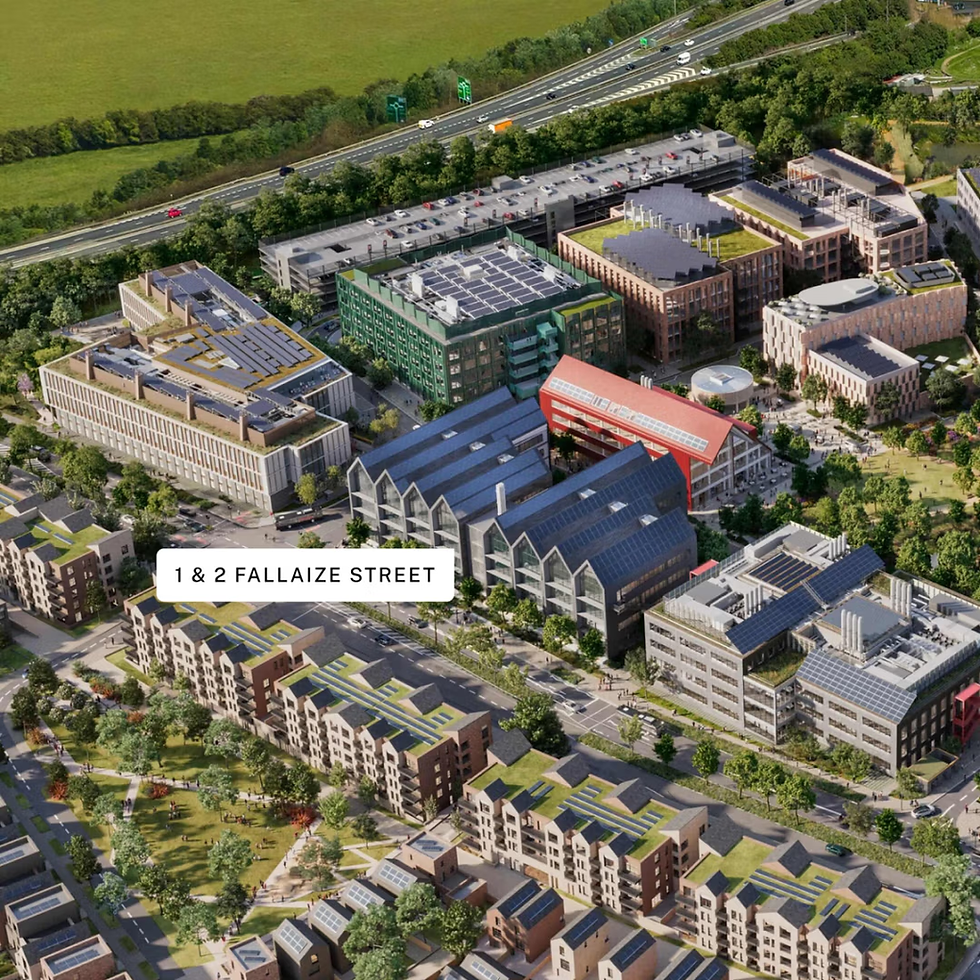
1&2 Fallaize Street, Oxford North
Two laboratory buildings providing exceptional workspace for companies ranging from SMEs looking to grow, to larger corporate occupiers seeking high-specification new workspace.
Each building will total 58,700 sq ft (5,453 sq m) NIA over ground and four upper floors and offer the ideal space to develop ideas, collaborate and innovate.
With fitted lab space available starting from 1,000 sq ft (92 sq m) and space up to 115,000 sq ft (10,683 sq m), the lower 3 floors have been designed and enabled to accommodate laboratory uses on a 60/40 lab/office split.

Oxford North says:
As a low-carbon district, the buildings will be all-electric and energy-efficient, powered by renewable sources and on-site photovoltaics, and will target BREEAM Excellent.
Oxford North Ventures is the joint venture company of Thomas White Oxford, the development company of St John’s College, Ontario Teachers' Pension Plan and Stanhope.
The project has a resolute focus to ensure that Oxford North has a far-reaching positive impact on the local economy through the delivery of its Community Employment Plan.
Since the project started, 1,067 construction jobs, of which 25% are currently locally based, and 22 new apprentices have been employed through the project’s three construction partners: Laing O’Rourke, Careys and The Hill Group.
The new park and market square have been named after Professor Elizabeth Fallaize (3 June 1950 – 6 December 2009) who was a British academic, a leading scholar in French Studies and was pro-vice chancellor (education) of the University of Oxford.

The Life and Mind Building
Opened this year, it is believed that the Life and Mind Building in Oxford, will significantly enhance the way that psychological and biological sciences are undertaken, helping researchers from around the world to solve major global challenges. It will be home to Oxford University's Department of Experimental Psychology and Department of Biology. Funding and delivery of the building are being undertaken in partnership with Legal & General.
Arup, the global engineering and sustainable development consultancy, was the project manager since inception, said:
'It is also home to the new INEOS Oxford Institute for the study of antimicrobial resistance, a major future threat to global health, bringing £100M in funding for research.
'Working alongside senior university stakeholders, as well as the dedicated project team – comprising NBBJ, Ramboll, Hoare Lea, Arcadis, Savills, Fira Landscape Ltd – and main contractor, Wates Group, Arup managed the project from inception to completion over an eight year period.
'Initially appointed as multi-disciplinary consultant for the options appraisal, the firm provided robust benefits-led analysis and produced the strategic outline business case which played a key role in securing capital funding and shaping the building’s vision and priorities.

'Arup led a programme of value-management and value-engineering, alongside cost partners Arcadis, which achieved a significant saving in the initial forecast project cost.
'By establishing a function-led approach to defining user requirements, architect NBBJ's design achieved a 21% reduction in floor space compared to the original facilities. This strategy also accommodated a forecasted 23% increase in staff and student headcount to support planned future growth.
'The building offers over 269,000 sq ft of transformative spaces for teaching, research, innovation and public engagement. It will provide a home for more than 1,400 scientists, academics, researchers, support staff and postgraduate students and become the main teaching location for around 1,000 undergraduate students with new lecture halls and teaching spaces.
Tim Crow, Director at Arup, commented: “Delivering the Life and Mind Building presented Arup with an exceptional project management challenge – realising the University’s transformative vision within ambitious constraints of performance, timeline and affordability.
“The LaMB project team rose to that challenge and have now created a building which delivers exceptional value for money and spatially efficient design, accommodating more research staff and students in less space. We are so pleased that Oxford’s world-class scientists now have a future-ready home for discovery and collaboration.”
The cost has been reported as £200 million.

Merck Life Science Advanced Research Centre (LS ARC), Darmstadt, Germany
HENN Architects reports:
'The Merck Life Science Advanced Research Centre is a new research building designed by HENN for Merck’s global headquarters in Darmstadt. The new building brings together research on key technologies of the Life Science business sector of Merck. These include raw materials and processes for researching and manufacturing antibodies, recombinant proteins and viral vectors. The company also researches cell culture media and pharmaceutical formulation and purification aids as well as digital reference materials. In addition, the scientists are developing analytical chromatography further. Research along the mRNA value chain will also be based in the new centre.

'The new Merck Life Science Advanced Research Centre is a global model for the laboratory of the future. It will be a place where laboratories, offices, and communication areas interlink to form a large, coherent world of knowledge. The building utilizes the synergies and potentials of work processes by connecting the spaces, which provide ample flexibility for subdivision, across floors in the horizontal and vertical direction.
'Facing the city centre, the building will be a cornerstone of the new research and development campus. This campus is being built along the so-called Innovation Mile marked at its southern end by the Innovation Centre at Emanuel-Merck-Platz, which was also designed by HENN'.
In April 2024 Merck reported that it was 'investing more than € 300 million in a new research centre at its global headquarters in Darmstadt, Germany. In the Advanced Research Centre, the Life Science business sector will research solutions for manufacturing antibodies, mRNA applications and additional products required for biotechnological production, among other things. As of the start of 2027, it will provide space for around 550 employees.
'On 24th April 2024, Merck laid the cornerstone for the building together with German Federal Chancellor Olaf Scholz. The new building is part of an investment program in the Darmstadt site: Merck will invest around € 1.5 billion in total by 2025.'
Comments