


Future Cities Forum Awards Winter 2026 with judges' comments
Updated: Jan 24

An all-female judging panel - drawn from leading professionals across local authorities, development and construction, universities, infrastructure operators, arts organisations and architecture and urban design practices - assessed a shortlist of eighteen projects spread across six categories. The judges were asked to focus on outstanding design vision and on sustainability when making their comments - highlights of which are included below.
Judging panel
Rokia Raslan
Professor of Built Environment Decarbonisation at the UCL Institute for Environmental Design and Engineering (UCL IEDE)
Laura Dyer MBE
Deputy Chief Executive Places, Engagement & Libraries (Executive Board Member) at Arts Council England
Donna Nolan
Chief Executive, Watford Borough Council
Vicky Smith
Executive Director of Strategy & Major Projects, National Museums Liverpool
Jenny Gardner
Design and Construction Director, Advanced Research Clusters (ARC) and Harwell Campus
Federica Buricco
Master-planning Studio Practice Leader at HKS Architects and Designers, London office
Liz Sparrow
Architect, Partner and Science Sector Lead, Ridge and Partners LLP
Diane Metcalfe
Head of Architecture, HS2 Ltd
1
Museums – international category
Cultural infrastructure is vital to human health and well-being as well as to the prosperity and attractiveness of cities. Do these buildings have practical strategies to open out to communities beyond their physical walls and how are they achieving this? Do they act as modern cultural anchors for the confident self-expression, brand, and identity of their cities?
WINNER
PoMo Museum, Trondheim, Norway
Vicky Smith commented:
'I loved the interventions in the PoMo project, the colour and flow through the building. Where you re-use a building it is always a positive for sustainability.'
Laura Dyer added:
'The Trondheim has both aspects of the renovation as a heritage asset in itself and siting the museum in the heart of the community. The gender equality of 60% of the acquisitions budget devoted to female artists is a very good thing as it is very much a live issue. The use of warm colour referencing Norwegian folk art is very strong so this pipped the Harlem New York project, which also has a strong sense of rootedness in the community.
RUNNERS-UP
Zayed National Museum, Saadiyat, Abu Dhabi
Studio Museum in Harlem, New York
Please see project details here:

2
Heritage and retrofit
How can heritage best be respected and remodelled to suit modern uses? How can it be used to create better community engagement? Are the spaces created within heritage buildings sympathetic to the original design? Are materials used wisely to work in with the original buildings design.
WINNER
Barts North Wing
Donna Nolan commented:
'Barts North Wing has very sensitively brought together the historic assets with modern healthcare access and it's very relevant today. as we go through the New Hospital Programme.'
Rokia Raslan added:
The Lambeth Palace project really ticked the boxes on integrating future tech with heritage sustainability especially, for keeping the building viable and for long-term resilience.
Diane Metcalfe said:
'It's a really great story that Barts North Wing is accessible by staff and patients at the hospital, that they may visit and use this beautiful space...our medical staff and patients do need some joy in their lives.'
RUNNERS-UP
Elizabeth Tower, Palace of Westminster
Lambeth Palace master-plan
Please see project details here:

3
Science and university buildings
How are they being designed to be open to the community, and how do they provide space for creative interaction?
Do their designs add significant identity and brand to their neighbourhoods and city locations?
How well do their sustainability credentials stand up?
WINNER
Life and Mind Building, Oxford University
Professor Rokia Raslan said:
'I like that Oxford North looks at not just science but the impact on the local economy while sustainability and community engagement have been thought about in detail. The Life and Mind is a great project by Arup, which has a team well equipped to understand nuances of sustainability..'
Jenny Gardner added:
'I toured the Life and Mind Building before Christmas....it is definitely a passion project with many of the team working on it for ten years plus and that really comes through in the attention to detail. They have done a great job on opening up the really difficult street corner to accommodate pedestrians and cyclists, and raised the building height to provide more space. They have been very good at weaving different types of science together in one building and making spaces to meet. There is a separate entrance for children and the elderly - important for the out-reach. The effort really shows.'
Federica contributed the HKS knowledge of the Merck Centre:
'The view is that the Merck building is innovative in its combination of laboratory types. The scheme from a urban perspective is very well integrated into the environment with strong contribution from landscape design. The quality is impressive with lots of light and green. It is situated in an industrial area close to the centre so it is a regeneration project and it could become a magnet for further development. They have given the building a lot of quality.
RUNNERS-UP
1 & 2 Fallaize Street, Oxford North
Merck Life Science Advanced Research Centre (LS ARC), Darmstadt, Germany
Please see project details here:

4
Housing (small schemes)
While local authorities struggle to meet government targets for large scale housing, there is a need for smaller developments too. The projects chosen are all on brownfield sites and close to amenities.
Do these schemes present a solution to the challenges of providing affordable housing?
How sustainable are these schemes and do they suit their purpose?
How are modern methods of construction (MMC) used and are the designs innovative/best in class?
WINNER
Gap House, Bell Close, Bristol
Vicky Smith said:
'I used to work at Bristol City Council...we were at the Bristol Housing Festival some years ago trying to bring in 'half way' accommodation to bridge homelessness and youth hostels to full renting or ownership. so this is a really valuable typology in housing. with the approach of using garages or car-parks to build on. There is a great use of colour in the Bristol project. They have created outside space in a tight site.'
Liz Sparrow added:
'This category felt hopeful. Peabody and Bristol were neck and neck. Gap House pipped it for me for its repeatability and what it did with one of those really difficult sites that nobody knows what to do with it. We need more of this.'
Federica Buricco added her comments on Swinegate:
'It is the answer to a question faced by many, many councils in the UK. - what to do with under-utilised parking lots? There is a huge supply, not much demand. There is push to reduce car use. It ticks many boxes..'
RUNNERS-UP
Morpeth Road, Hackney
Swinegate, Grantham
5
Schools
These projects focus on developing important skills for students in the arts, at a time when these might be overlooked with the emphasis on STEM subjects. How can new creative hubs inspire ideas, cross-disciplinary skills and performance in the younger generation? How can the facilities create confidence in pupils, while adding significant visual presence to their campuses?
WINNER
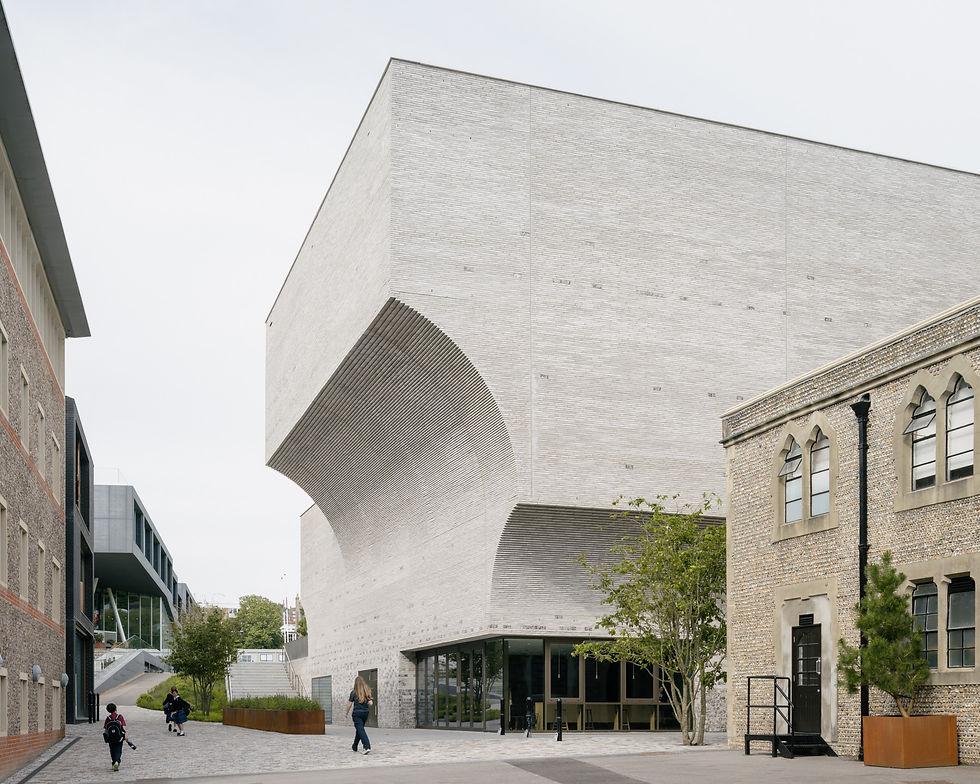
Performing Arts Centre, Brighton College
Jenny Gardner:
'Brighton is a stand-out project with beautiful detailing and wood. St Paul's Girls School is probably the best from a sustainability point of view.'
Liz Sparrow commented:
'Brighton from its architectural execution is the stand-out project. It has been taken from a very strong single idea and executed to the Nth degree. It is a celebration of architectural wonder and the people in the city can see it.'
RUNNERS-UP
Design Hub, Talbot Heath School, Bournemouth
Rosalind Franklin Wing, St. Paul’s Girls School London
Please see project details here:

6
Hotels
There has been significant investment in hotels over the past year. How do these short-listed projects attract responsible tourism and enhance the brand of their locations?
How can new hotel design help to present an outstanding guest experience while addressing sustainability in construction and operations?
Are these projects pushing the boundaries of hotel design or offering up tried and tested hospitality?
WINNER
Hotel Kymaia, Puerto Escondido, Oaxaca
Donna Nolan commented:
'This scheme demonstrates the strongest alignment with responsible tourism and sustainability. Its use of rammed earth, palapa structures, passive cooling techniques, solar generation, constructed wetlands and mangrove restoration shows genuine environmental stewardship. The design is rooted in local culture and landscape, offering an authentic, low‑impact approach to hospitality.'
RUNNERS UP
30, Grosvenor Square, London
Maison Heler, Metz, France
Please see project details here:
Copyright 2025: The Broadcast PR Business / Future Cities Forum
Comments