


Future Cities Forum's 2026 Summer Awards entries short list

Future Cities Forum is releasing its Summer Awards 2026 awards categories and entries. The categories are workplace, tall buildings, airport design, retrofit with two separate cultural sector categories.
WORKSPACE
1) Pall Mall Court - Manchester (image above, courtesy of Sheppard Robson)
Sheppard Robson says:
'85,000sqft Grade II-listed development transformed from a stranded asset into a modern workplace, faithfully recreating its 1960s form while reshaping its relationship with Manchester city centre.
'On behalf of Bruntwood SciTech - the UK’s largest property platform dedicated to the innovation, tech and science sectors - we have rethought the urban presence of the development, which comprises three blocks bound by King Street, Marsden Street, Pall Mall, and Brown Street.
'The entrance has been relocated from Pall Mall to the centre of the development, creating a new public piazza, Pollen Square, named after the building’s original architect, Brett, Pollen & Teggin.
'Now recognised by the UK Green Building Council as a national exemplar of deep retrofit in a listed commercial setting, the project demonstrates how heritage-led regeneration can deliver architectural integrity alongside high-performance environmental outcomes.'
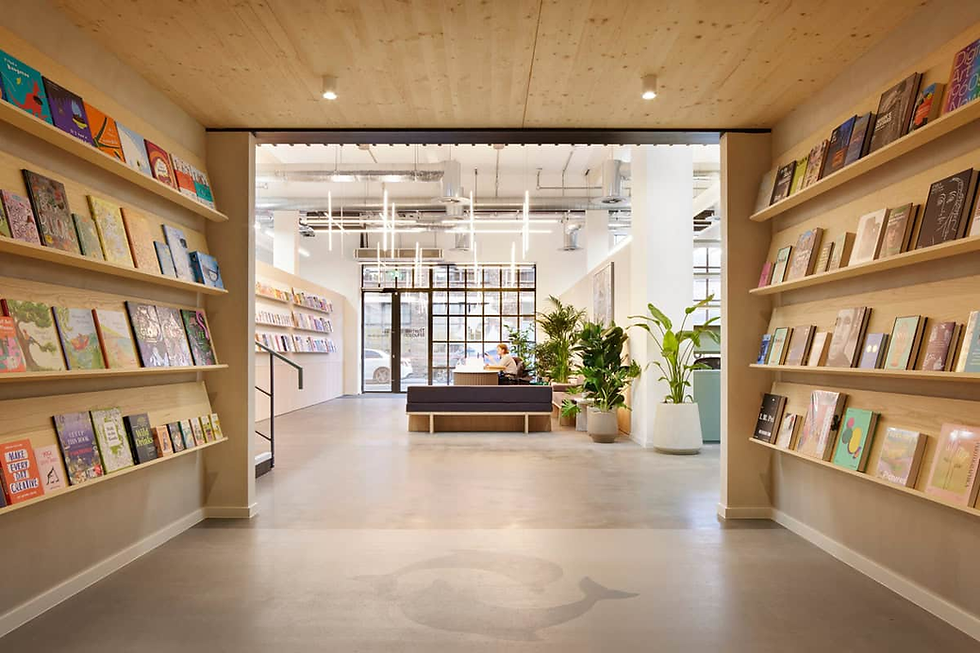
2) Thames and Hudson HQ at King's Cross
Architects practice Vertus says:
'Following two decades at their Holborn headquarters, Thames & Hudson embarked on an ambitious relocation to the vibrant city fringes of London, selecting a 16,000 sq. ft. space in the former Gagosian Gallery at Kings Cross. We had previously transformed the space, alongside Stanton Williams into a stunning CAT A office space with polished concrete floors, timber-lined mezzanines, and exposed services. Following the successful completion of the CAT A space, Virtus Designworks were approached to design a CAT B proposal that celebrated the company’s collaborative ambitions and showcased their publications.
'A key design feature of the proposal was to place emphasis on the various divisions in the business. By creating neighbourhoods that allowed the departments to sit together within the context of the open-plan space. The business has been able to move from five floors of office, to one open plan space with a mezzanine. This change supports their wider strategy of collaboration and communication.
'The successful delivery of Thames & Hudson’s relocation was not without its challenges, particularly in managing the intricate interface between client direct contractors and our own supply chain. With multiple specialist trades operating concurrently, meticulous coordination was required to ensure seamless integration, while maintaining programme and quality standards.
'A key complexity arose from the installation of M&E plant, fixtures, and fittings within bespoke joinery elements. This required a highly collaborative effort between our site team, designers and specialist trades. Given the bespoke nature of the joinery, precise spatial coordination was critical to ensure services could be integrated within, while guaranteeing both functionality and aesthetic intent.
'Through detailed workshops and early procurement of key components, we were able to mitigate installation risks and avoid costly reworks, ensuring the outcome aligned with the high-end design vision.

Image: CGI of the Turing Building - courtesy of AFK
3) The Turing Building at Stratford Cross, London
Architects Armey Fender Katsalidis (AFK) says
'The Turing Building is a next-generation commercial office building for Lendlease, sited at a key gateway point within the pioneering new Stratford Cross in East London. The ambition was to create an exemplary commercial building to attract tenants, inspire collaboration, and support new ways of working while exploring the notion that the spaces in between are just as important as the buildings themselves.
'The Turing Building is a key part of the emerging Stratford Cross district, standing at a key pedestrian gateway. The building's articulation, scale, and depth were extremely important to achieving a form that is both distinct and memorable, but also harmonious with its neighbours. Vertical ‘cuts’ and gasket lines are carved out of the massing to create a bold and robust form, echoing the site’s industrial railway heritage, as well as a visual indication of the different uses within the building - which include offices, a cinema, retail and an active and flexible lobby (or 'third space'). The building's stepped roofline creates a silhouette with variety and interest, adding to the skyline and adhering to the overarching principles of the masterplan.
'Outdoor terraces are also sculpted out of the building’s mass, offering great views across Stratford Cross and adding commercial value to the office floors, supporting the return to work and strengthening productivity while boosting the well-being of its users.
'The building is designed to be as flexible as possible. While it is predominantly commercial, it embodies ‘loose-fit, long life’ principles, meaning it's designed to adapt over its lifetime. An efficient mix of low- and high-rise office floors is stacked above a two-storey podium containing an active and flexible lobby, retail and an integrated cinema ‘box’. The wide floorplates on the office floors are designed to allow for easy subdivision and are adaptable to suit a variety of arrangements and multiple tenants. Moving the core to the side of the building allows a wash of natural light into the washroom facilities.
'The ground floor podium and open public lobby are intended as a 'third space' - a loose and flexible space for a diverse range of uses, such as cafe spaces, impromptu meetings and programmed events. The Turing Building is the first building within Stratford Cross to incorporate a 'third space', adding value through multiple uses and for multiple audiences, extending the life of the building throughout the day and night and embedding it as an asset for the wider community. This creates a vibrant social hub at the base, generating activity and drawing people around and into the building. It communicates with the surrounding urban fabric, contributing to the intensification of the public realm.
'The Turing Building is exceeding original sustainability targets by achieving BREEAM ‘Outstanding’. WELL ‘Gold’ is awaiting verification. The building has a +30 % reduction in embodied carbon, 90 square meters of onsite solar panels, and 57 % reduction in water demand.

Image: V&A Museum East, courtesy of O'Donnell + Tuomey
CULTURAL CATEGORY A
1) V&A East
Architects O'Donnell + Tuomey describes the newest addition to the V&A family of museums which opened in April 2026 as part of the significant East Bank district on the Queen Elizabeth Olympic Park, alongside the London College of Fashion (UAL), BBC Music Studios and Sadler's Wells East:
'A new museum where visitors can explore the V&A’s world-renowned collection and the best of today’s art, design and performance. The new building houses pioneering exhibitions, gallery displays, events and activities, spaces for community-led projects, installations, and creative collaborations - and a café, shop, outdoor spaces and great views over the Park.
'Cristóbal Balenciaga was an influential Spanish couturier whose exquisite craftsmanship and innovative designs shaped modern fashion. A major exhibition celebrating his work was held at the V&A in 2017 in which curators drew attention to Balenciaga’s use of the Japanese concept of “Ma”, or “the space in between”. His tailoring provided a sculptural sense of space between the body and the enclosing fabric; framing rather than restricting the figure.
'This has been an important influence on the design team’s concept for the new V&A East. As with Balenciaga’s creations, the outer skin of the new V&A building acts as a three-dimensional ‘folded dress’, lending the museum a distinctive form and striking identity. V&A East has been designed as a statement structure with a distinctive facade that wraps the building. The angular outer skin appears different from various approaches and view points.
'The folded facade, crafted in intricate detail, gives strength and identity to the architectural form. The exterior is formed from 479 sand coloured precast concrete panels, each uniquely shaped and scored with profiles that reference the V&A’s distinctive logo. The linework of the panels align to create a unified pattern along the three-dimensional folded façade that catches the changing light over the course of a day, animating the building’s exterior. Benches integrated into the façade at ground and podium level bring people into close contact with the building and extend its threshold into the public realm.
'V&A East Museum opened on the 18th April this year. The museum has been co-curated with young people, creatives as well as those living, working and studying in east London. In a brand new five storey space, the museum is next to the East Bank Partners London College of Fashion / UAL, the BBC, Sadler's Wells East and UCL East. Supported by the Mayor of London, V&A East Museum is sister site to the critically acclaimed V&A East Storehouse which opened in May last year.'
Also
Future Cities Forum interviewed the Director of V&A East Gus Casely Hayford in 2021 about the vision for the new and complementary V&A East Storehouse located near to the East Bank ay Here East. He said:
'With a newly designed space which is vast - the scale of a football field - we will have a glorious new museum when built: There will be multiple floors where visitors can stand to look up and look out and 26,000 objects to explore. Those who are interested can look at best practice from designers around the world. There will be a newly designed state of the art exhibition space where the narratives from our creative communities can find space and present the reactions to the objects from the local community.
'We will draw in marginalised audiences and provide a digital interface which will bring the collections to life. Visitors will be able to record their impressions and leave something of themselves behind. We will create another layer of integration of objects - a space within itself - to seek out and explore the latest debates around the objects.
'There will be facilities for courses and for training. We have set up a connection with The Bartlett / UCL and The London College of Fashion for training and people will be able use this wider partnership to further their own professional opportunities, creating a new community of artists and by so doing, bring back into our own collections.'
Gus concluded our discussion event by saying
'We don't want to be passive as a museum in East London but engage, whether it be through tertiary education or via the national curriculum through physical or the digital, enabling people to access jobs or enjoy the museum through handling the objects. In short, the objects are 'Yours' and in the spirit of our founder Henry Cole, it is there to 'Fulfil your dreams'. Some of the collection is 'contentious and difficult' and we are motivated to live up to the higher ideas of museology but we want to change the way people see our collections, now and in the future'.

2) National Geographic Museum of Exploration - Washington DC
National Geographic CEO Jill Tiefenthaler explains the mission and rationale for the new museum:
'On June 26, the National Geographic Society will open the Museum of Exploration (MOE), the most significant expansion of its campus in history. A “treasure trove” of archives — maps, artifacts and footage that would stack to the height of Mount Everest — combined with immersive technology, it is the Society’s latest chapter of its 138-year storytelling legacy. CEO Jill Tiefenthaler views it as the global nonprofit’s next evolution, a space designed to inspire awe and action.
'The Museum of Exploration is an invitation to step into our mission and, at the heart of our mission are National Geographic Explorers. They are the amazing scientists, conservationists, educators and storytellers who are dedicated to illuminating and protecting the wonder of our world.
'The Museum immerses you in over 100,000 square feet of exploration in a state-of-the-art, uniquely National Geographic space. Inside, you can learn about how Explorers are decoding the language of sperm whales, uncovering dinosaur species that reshape our understanding of ancient history, protecting fragile wildlife and ecosystems and so much more.
What makes the MOE different is that you experience exploration through their eyes. It’s an immersive “Home of Exploration” where you’ll see the tools Explorers use in the field: the camera equipment they haul over extreme landscapes, the telescopes pointed at the night sky, the gear worn to the world’s highest peaks and the expedition vehicles still caked with dirt.
'By stepping into their worlds, we hope you leave with your own spark of curiosity. We want every visitor to walk out of the doors feeling the wonder and possibility about their own journey of exploration and discovery. Because at National Geographic, we believe there is an Explorer in everyone.
'Over the last few years, I’ve had many people ask me some version of “Why a museum?” and “Why now?” I always tell them that the MOE is the next step in a legacy of storytelling innovation — a legacy that stretches back to our founding in 1888.
From our earliest days, the National Geographic Society has supported Explorers and amplified their work to the world. What I love about National Geographic is that we’ve never been defined by one medium. We’ve always evolved to meet people where they are.
'In the beginning, crowds lined up outside our Washington, D.C. headquarters to get a seat at a lecture about the latest expedition. National Geographic magazine carried these discoveries into homes around the world. Later, we produced primetime TV specials and launched our own global channels. As we entered the digital age, we streamed into classrooms and onto smartphones, building one of the largest social media communities on Earth.
'The MOE is the next chapter in that evolution.
'We’re combining our rich storytelling legacy with today’s technology to create a space that invites you into our Explorers’ journeys in new ways. You can find your favourite magazine cover on our digital magazine wall and revisit iconic National Geographic moments throughout our history. In a time where everything competes for our attention, there’s no substitute for in-person experiences that truly wow you.
'How do you want visitors of all ages to feel when they visit the MOE and step into the world of our Explorers? What do you hope they take with them?
'If I had to sum it up in one word: awe.'
'I’m an economist by training, so I’ve always believed in the power of data. But at the Society, I’ve come to realize that it’s awe that moves people to care, and act.'
Visit D.C.’s Newest Museum

Image: Kanal, courtesy of noAarchitecten, EM2N, Sergison Bates architects
3 ) KANAL Centre Pompidou (Brussels)
The Centre says:
'Kanal is uniquely located on the banks of the Charleroi-Brussels Canal. The docks on which the building stands, were drained in the early 20th century. From 1912 to 1916, the site was home to the "Luna Park de Bruxelles", a large amusement park with a fairground, bowling alley, restaurant and theatre, where Brussels and non-Brussels flâneurs loved to come for a stroll.
'In the early 1930s, car tycoon André Citroën bought the plot to build a new flagship plant. At his request, the architects Alexis Dumont, Marcel Van Goethem and Maurice-Jacques Ravazé designed a "cathedral for cars": a huge modernist complex, built from concrete, steel and glass, boasting numerous workshops and a 21-metre-tall showroom as the absolute eye-catcher.
'For a long time, the building was the largest garage in Europe. After the Second World War, in preparation for the 1958 World Fair, a large viaduct was constructed on Boulevard Leopold II, skirting the Citroën garage. In response, the showroom was divided into several levels, making sure that passing motorists could still gawk at the latest car models on display.
Between 1953 and 1966 the grounds adjacent to the garage were home to the Héliport de Bruxelles, on what is now Avenue de l'Héliport. The landing of the Rolling Stones was one of the last highlights in the heliport’s storied history.
'A new era began when Citroën moved shop and vacated the premises in 2014. In 2015, the Urban Development Corporation of the Brussels-Capital Region (SAU-MSI) bought the garage with the ambition to transform it into an international cultural centre. It launched an architectural competition and transferred control to the Kanal Foundation. The winning bid A stage for Brussels by Atelier Kanal (noAarchitects, EM2N and Sergison Bates architects) was unveiled in early 2018.
'The award-winning design is now being developed into a new museum for Brussels, Kanal-Centre Pompidou, with the Brussels-Capital Region as a key partner. The project will also incorporate CIVA, the Brussels centre for architecture, landscape and urban planning. A temporary agreement was signed with the Centre Pompidou in Paris, which will run until five years after Kanal’s opening. That opening is scheduled for 2026. Between Kanal, the next-door Kaaitheater and the vibrant quartier beyond, the site will once more become a happening place where Brusselers and non-Brusselers can enjoy a stroll, celebrating art together.'

Image: EDGE London Bridge - view to entrance and along St Thomas Street eastwards, with station entrance left (courtesy Pilbrow & Partners).
TALL BUILDINGS
1) EDGE London Bridge
Pilbrow and Partners says:
'EDGE London Bridge, situated within the emerging tall-building cluster near The Shard, is set to be one of the country’s most sustainable tall buildings.
'The first UK project by pioneering real estate developer EDGE, the slender 28-storey tower will offer exemplary workspaces to both established businesses and local start-ups. The building’s open, four-storey plinth will comprise a publicly accessible lobby, café, auditorium and free flexible workspaces.
' It will also provide tenants with accessible outdoor spaces including a new public park, planted balconies and a shared roof terrace, plus a fully equipped gym and over 500 cycle storage spaces. The tower's expressed structural frame honours Bermondsey's Victorian engineering heritage. Inside, the design fosters vertical connectivity, promoting interaction across levels, with flexible CLT floorplates allowing for adaptable internal configurations.
'The compact plan is designed to deliver generous daylighting and panoramic views, while the high-performance glazed terracotta elevations will optimise shading and minimise solar heat gain and glare. Openable façade elements on each level will offer natural ventilation, while smart building technologies, including chilled ceiling panels with integrated lighting sensors will enhance workplace comfort with minimal environmental impact.
'The building is designed to achieve BREEAM Outstanding and WELL Platinum accreditations. Bold, vibrant and verdant landscaping is conceived as an integral part of the public realm, and will cascade into the building interior, increasing the site’s biodiversity and allowing workers and residents opportunities to connect with nature in this urban setting. Bespoke design elements also include signage made from clay salvaged from the foundations.'

Image: courtesy of CityLife
Milan CityWave
CityLife describes the building in Milan:
'The project designed by BIG (Bjarke Ingels Group) will mark the completion of the redevelopment of the former Fiera Campionaria area, a transformation that began in 2005. This ambitious plan serves a dual purpose: expanding commercial spaces for business, hospitality, and dining activities, and creating a spectacular gateway to Milan’s iconic new district and its vast park. The original brief called for the construction of two separate buildings on the designated plots, with different heights and volumes. However, the Danish firm took the concept one step further: “...Rather than competing with the existing surroundings, we aimed to complete them,” states the project’s architects..
'The structure consists of two buildings, named East and West, connected by a dynamic wave-like structure - hence the name CityWave - stretching over 200 metres, intersected by a large green area. It will add a Gross Leasable Area (GLA) of approximately 63,000 square metres to the existing 130,000 square metres of the CityLife Business District, bringing the total to nearly 200,000 square metres for office and retail space. The entire canopy connecting the two new buildings will be fully covered with photovoltaic panels, making the structure almost entirely energy self-sufficient. This will become Milan’s largest urban photovoltaic park and one of the largest in Europe, covering approximately 11,000 square metres and generating an estimated 1,200 MWh of electricity per year.'

Image: 2FA at Broadgate, City of London - courtesy of 3XN for British Land
2 Finsbury Avenue at Broadgate, City of London
3XN says:
'2 Finsbury Avenue (2FA) at Broadgate is located at the largest pedestrianised neighbourhood in Central London. The project consists of a 12-storey podium with a 21-storey West Tower and 36-storey East Tower. In line with the client’s sustainability strategy, the building will target net zero carbon in construction and operation as well as a BREEAM ‘Outstanding’ certification.
'To achieve this ambitious goal, a series of forward-thinking environmental initiatives will be incorporated. To ensure flexibility for current and future needs, the offices have been designed with behavioural scientists from GXN and are interspersed with healthy, green areas and terraces to inspire creative collaboration and social interaction.
'2 Finsbury Avenue is located in the North-West corner of the Broadgate mixed-use campus in the City of London next to the busy transport hub of Liverpool Street.
“Our design takes its starting point in our analysis of the campus. The Broadgate campus offers a diverse offering of amenities, spaces to interact, dwell and work and we wanted to introduce these qualities to the building. Therefore, the building is perceived as a series of interconnected volumes, where the connecting points are the social spaces, amenities, green spaces, etc.”, says Audun Opdal, 3XN Senior Partner in charge of the London project.
'The project is part of British Land's Broadgate Regeneration and will include flexible workspace suitable for a range of occupiers, including incubators, start-ups and medium sized businesses. It will also house an open learning hub on the ground level to provide local communities with access to formal learning programmes, informal networks and talks from institutions.
'Connecting to the existing neighbourhood is a central element of the design and a public route under the building will extend Finsbury Avenue to create a new route from Eldon Street to Sun Street via Finsbury Avenue Square.
Public access to the building will be delivered through the inclusion of a new learning hub fronting on to Sun Street and Wilson Street.'
AIRPORTS

Image: courtesy of Cox
Sydney's new airport
Architects Cox says
'Western Sydney International (Nancy-Bird Walton) Airport (WSI) is a once-in-a-generation infrastructure project that will connect the future social, cultural and economic hub of the Western Parkland City with the world.
'Together with Zaha Hadid Architects, our design for the terminal redefines the airport experience for Australia – grounded in place, shaped by light and built for the future of aviation.
'Zaha Hadid Architects and COX Architecture won the international competition for the design of WSI in 2019, developing a concept design that captured the natural and cultural identity of Western Sydney through light, landscape, and movement. The design has since been delivered in collaboration with Woods Bagot as Lead Design and Delivery Architect, appointed by Multiplex. COX and ZHA were retained throughout delivery to uphold the original design intent – a defining design journey that carried the architectural vision from concept to completion.
'Located on Dharug Country, the terminal’s design reflects the natural beauty of the Cumberland Plain and is shaped through consultation with local Dharug Custodians, in collaboration with Murrawin. The design integrates local identity, natural light and intuitive navigation to create a calming and welcoming space that puts people at its heart.
'Stretching low across the landscape with soft curves and a warm, earthy material palette, the design for the terminal draws inspiration from the region’s native flora and expansive horizons — particularly the filtering of light through the curling bark of eucalyptus trees. Undulating gently overhead, the terminal ceiling stands as a central design feature. Inspired by the play of sunlight through eucalyptus bark – its sculptural, functional form intuitively guiding the movement of travellers through the terminal. Every detail is designed for clarity and calm, making the journey from arrival to departure feel effortless and connected to place.
'Signature elements include the terminal’s aerodynamic roof form, undulating ceiling curves and sculptural leaf pod retail kiosks that rise organically from the floor. Warm materials such as terracotta, deep greens, timbers and woven textures reference the tones and textures of the Cumberland Plain, bringing regional identity into every detail.
'Environmental performance and future adaptability were key drivers of the concept. The terminal targets a 5 Star Green Star Rating, integrates natural ventilation and daylighting strategies and features a modular layout designed to support long-term growth and evolving technologies. The roof’s aerodynamic, single-ridge form — inspired by aircraft wings — reinforces the building’s identity and contributes to intuitive navigation.
'As the first major international terminal built in Australia in over 50 years, WSI represents a generational milestone in the evolution of Sydney’s civic and transport infrastructure. The project reimagines the passenger journey — elevating design, clarity and connection — to welcome the world to Western Sydney.'

Image: Noida Airport, courtesy of Grimshaw
Noida Airport India
Architects Grimshaw says:
'The design of the airport terminal merges Swiss efficiency and Indian hospitality, as it provides a seamless passenger experience and sets new benchmarks in sustainability for airport terminal buildings in India.
'All users of the airport, including the airlines that will use it as a base, want, perhaps above all else, to feel that it is a well organised machine: safe; reliable; efficient and punctual. Meeting these minimum requirements allows the airport’s users to relax, creating the opportunity for enjoyment in the moment. It is here that the sense of warmth and generosity that is so particular to Indian hospitality has the potential to elevate the experience of all airport users into something genuinely rewarding and memorable.
'For us this means: creating an airport with a unique identity that is unmistakably of its place; providing attractive landside spaces to dwell in with, colleagues, friends and family at departure or arrival, or whilst using the multi-modal interchange for interstate-travel; making all passenger journeys clear, intuitive and convenient; supporting the integration of digital technologies that ease passenger stress; providing a range of retail that offers convenience and delight for a wide array of target audiences; and creating spaces that people love to inhabit by the integration of natural light and landscape throughout the passenger journey.
'The design solutions for NIA aim to deliver a truly net zero carbon project, minimising energy demand through a combination of intelligently integrated passive design elements, that are responsive to the local climate and that understand human behaviour, whilst coordinating carefully with the overall on-site renewable power generation that is planned by the wider master-planning team.'

Image: courtesy of Foster + Partners
Techno International Airport, Cambodia
Foster + Partners says:
'Located 20 kilometres south of the city centre, Techno International Airport in Phnom Penh offers a new vision for Cambodia’s capital. The design embodies a strong sense of place, drawing inspiration from one of the oldest civilisations on earth, inspired by its vernacular forms, and responsive to the tropical climate. The overall masterplan by the practice includes plans for a new airport city with a state-of-the-art terminal building at its heart, providing the highest levels of passenger experience and setting new standards for sustainability.
'The terminal building comprises a central head house with two aerofoil shaped piers either side that optimise walking distances. The head house contains all the passenger processing, security and immigration, and retail elements under a single overarching roof canopy that stretches from the drop-off to the airside, providing shelter from the elements. The roof – supported by structural trees spanning 36 metres – is a lightweight steel grid shell, with an innovative screen that filters daylight and illuminates the vast terminal space. Designed to be highly legible at a human scale, there are minimal level changes throughout the terminal and views out to the apron to improve clarity and make movement intuitive. Interior materials are warm and welcoming, evoking the Cambodian vernacular in a contemporary manner.
'Aspiring to be one of the greenest airports in the world, the project takes a sustainable design approach, combining the latest technology with local craftsmanship, whilst minimising running costs. Flooded with natural light, the terminal is full of lush greenery, with mature trees rising through the soaring central void and edge planting softening the interiors. The terminal will also be almost entirely run on energy generated by an onsite photovoltaic farm.
'The modular construction and phased project timeline enhance constructability. The terminal is strategically located to anticipate future expansion scenarios. The first phase of the airport terminal includes the central head house and the aerofoil wings to the north, accommodating up to 13 million passengers a year. Subsequent phases will include the second aerofoil wing, accommodating 30 million passengers.'

Image: Beacon Hall interior, transformed into a flexible 1,800 performance venue - courtesy of Tim Crocker / Levitt Bernstein
RETROFIT AND RESTORATION
Bristol Beacon - formerly Colston Hall (Levitt Bernstein)
The reimagination and restoration of Bristol Beacon sees this Grade II listed concert hall transformed.by a project team led by Levett Bernstein for Bristol City Council and Bristol Music Trust
Levitt Bernstein describes Phase 2 of the restoration and re-modelling project:
Following our work on the new foyer building, completed in 2009, this is the second and final phase of a project that promotes Bristol Beacon as an exemplar of international quality within the music industry. The original fabric of the Grade II listed building has been repaired, restored and upgraded, conserving the Byzantine Victorian architecture whilst adapting it for modern audiences and operations.
The project’s programmatic needs were extensive, including: the renewal of existing music performance halls and backstage areas; the remodelling of secondary spaces, such as the underused cellars, to introduce new music education studios and club-style third venue; and the insertion of new AV, stage engineering and upgraded building services. Additionally, a new restaurant has been incorporated within the historic colonnade, complementing the venues with a characterful dining space for visitors and audiences.
'

Rochdale Town Hall
Donald Insall & Associates reports:
'Designed by William H Crossland and opening in 1871, this Grade I-listed masterpiece is recognised as one of the most historically significant Victorian buildings in the country. By the 21st century, the building fabric had become compromised and deemed unfit for the changing needs of Rochdale Borough Council. Supported by the National Lottery Heritage Fund and led by Rochdale Development Agency, a series of design interventions have been made to improve physical and intellectual access to this much-loved building.
'In addition to extensive repair and restoration work undertaken to the most historically significant areas such as The Great Hall and the Mayor’s suite of rooms, previously unseen spaces are now accessible to the public for the first time. In the Bright Hall, unsympathetic 20th-century additions were removed to reveal a double-height ceiling, angles along the walls, and a hidden window into the Great Hall.
'A series of internal and external adaptations were made to consolidate circulation and unlock public access, including an accessible terracing that wraps around the building, which replaces a series of aesthetically detracting individual ramps while giving level access to all external entrances. A lift and staircase, along with a glazed entrance, has been installed in the Alfred Waterhouse-designed clock tower.
'The public realm has been transformed by removing surrounding roads and car parks. A multi-functional civic space, designed by Gillespies, offers a vibrant and accessible welcome to the Town Hall.'

Image: courtesy of Tim Crocker (photography)
Department - Carnival Parade at Ryde, Isle of Wight
Architects - Turner Works says:
'Shademakers, known for their incredible carnival work (large-scale kinetic sculptures, dancing installations, and a serious talent for bringing streets to life), have spent over three decades as a nomadic organisation. Now, they finally have a long-term base and it’s one with an open door, inviting Ryde’s creative community to step inside and be part of something special. With Ryde Carnival dating back to 1887, when the first procession was held to celebrate Queen Victoria's Diamond Jubilee, the town is widely considered to be the home of the UK’s oldest carnival tradition and so an ideal home for the Shademakers.
'For Turner Works, this project has been about more than just architecture. It’s about reimagining what our high streets can be and proving that old buildings can have bold new futures. The overarching goal of the project was to create a lasting, inclusive space for the local creative community. Shademakers initially occupied the building on a meanwhile basis prior to renovation, testing the building through events with partners including Stitch Department and Horse Box Theatre. Such temporary use enabled testing of design ideas and directly influenced the final design proposals. The building was designed to leave a legacy, providing future generations with a place to create, learn, and engage with art
'The building's rich history—spanning from an ironmonger's to dressmaker’s store—is a cornerstone of the project. The design choices honour the building's past while accommodating its new purpose. A multi-layered history is visible, original elements from wonky wooden floors to layers of structure are tied together with a kit of new oak, plywood and red metal parts. The building’s various phases and functions are reflected in the architecture, from the fabric of the structure to the decorative metalwork.
'A major design challenge was to improve circulation and ensure accessibility. The building was previously three interconnected buildings, each with its own layout. A deft cut in the smallest and oldest central building has allowed a new point of vertical circulation, whilst freeing up the spaces in the rest of the building for a range of functions. A new through route has been created from High Street to the rear of the building, making the Department a part of everyday life and encouraging the public to pass through and engage with its creative activities. The design consciously separates public, semi-public, and private areas. The ground floor has become a fully accessible public space with a gallery, shop, theatre, dance studios and audio booth. The first floor community cafe has been reimagined with a new layout and dining terrace, and are now accompanied by a variety of art classes and studios. The second floor is home to Shademaker’s own creative spaces.
'The design approach is resourceful and sustainable, working with existing grade II listed fabric. Rather than tearing down and starting anew, we focused on retaining and enhancing existing structures whilst interweaving new electrical and heating systems. Challenges such as roof repairs and improving thermal performance, were carried out with a careful approach, balancing heritage and modern construction methods to suit the tight budget. The project preserves the building’s history and reactivates it for future generations. Upcycled furniture is visible throughout the space, with upholstery and refurbished / bespoke joinery made by the clients own network of makers and DIY enthusiasts.'

Image: The Drift Museum - courtesy of Braaksma & Roos
CULTURAL CATEGORY 2 - museums by the sea
The Drift Museum, Amsterdam
'The Drift Museum, Amsterdam, set to open in 2026 in Amsterdam’s historic Van Gendt Hallen industrial complex, renovated by architecture firm Braaksma & Roos, is dedicated to the Dutch artist duo Studio Drift, renowned worldwide for their large-scale, technology-infused, kinetic installations.
'The museum is designed as an immersive, experiential environment rather than a traditional gallery, intended to inspire awe and foster a stronger bond with the planet and nature.
'Accessible by electric boat through an indoor harbour, the exhibition hall will feature the captivating works of Studio Drift (Lonneke Gordijn and Ralph Nauta), which cleverly explore the connections between nature, technology, and humanity.'

Image: courtesy of Hull Museums
Hull Maritime Museums says
'Restoring five of Hull’s key maritime heritage assets to place its 800 years of seafaring history is at the heart of the city’s visitor offer.
'With the creation of a new visitor experience to show Hull in a new and different light, the five sites will highlight the maritime heritage within the city’s striking landscape and also inspire people to cherish the heritage and experiences which have shaped the city and its people, for centuries.
'Not only will Hull Maritime transform the most important maritime sites, increasing access to and understanding of them, it will also have positive impacts for the city beyond the project itself, contributing to education, skills development, jobs creation, apprenticeships, internships and extensive volunteering opportunities.
'Overall, Hull Maritime will grow the sense of ownership and civic pride in Hull's heritage and make the city a more interesting, attractive and invigorating place for residents and visitors alike.'

Credit: Rossi Architects/Susan Dugdale & Associates
Larrakia Cultural Centre, Darwin
The BBC describes The Larrakia Cultural Centre as
'A striking new museum opening in September in Darwin, the capital of the Australia's Northern Territory. The harbourfront building has a roof shaped like a bird in flight, evoking an ancestral spirit. Built on the sacred land of the Indigenous Larrakia people, it's the latest example of a shift from museums about native people to museums owned and operated by them.
'The Larrakia, who have lived in the region for tens of thousands of years, have been working on the project for decades. "The centre will be a place of truth-telling, learning and celebration," Malarndirri McCarthy, the country's Minister for Indigenous Australians, said in a statement. It's hoped that visitors will come to the museum before heading out to explore other Indigenous sites in the region with cultural ties to the Larrakia, such as Kakadu National Park and the Tiwi Islands.
'The A$60m (£31.2m) centre will display traditional and ceremonial artefacts, some of which were repatriated only recently. Last year, the Fowler Museum at the University of California-Los Angeles returned a kangaroo-tooth headband and glass spear points that were acquired in the late 19th and early 20th Century. A few months later, Larrakia elders travelled to England to reclaim 33 spears, spear throwers and a club from the Bristol Museum & Art Gallery.
'In addition to galleries and art studios, the centre will have an outdoor auditorium with sand performance and saltwater ceremonial areas and spaces to teach the Larrakia culture. It will also have a restaurant featuring indigenous flavours, and a shop selling Larrakia arts and crafts.'
Comments