


'Innovation Cities' - Future Cities Forum's report part two

Image: railway tracks running into Bristol Temple Meads Station, taken from the Executive Boardroom Suite at The University of Bristol's Sloane Robinson's building, courtesy of Future Cities Forum, looking beyond towards Temple Quay and Castle Park.
Future Cities Forum is publishing its report part two from its 'Innovation Cities' discussion at The University of Bristol's newly opened Sloane Robinson building at Bristol Temple Quarter.
This part of the report covers the future development of Brabazon (formerly an RAF base which became the commercial Filton aerodrome where Concorde was partly designed and built) , the need for larger IT and data capacity in the growing region to support business and defence, the demand for high-quality master planning and place-making, along with the protection of heritage, sustainable student accommodation, the future voice of local leadership and the key to attracting international and domestic investment.
The contributors to this part of the discussion were Simon Fitton, Planning Director, YTL Developments, Sophie Broadfield, CEO, Bath and North East Somerset Council, Andrew Munday, Global Technology Director, Babcock International, David Varney, Partner, Womble Bond Dickinson, Tom Jackson, Development Director, MUSE Places, Andrew Brown, Associate Partner, Ridge and Partners, Jonathan Lambert, Development Director, Savills along with Marcus Richards, Partner, EY, Clare Wilks, Director and Bristol Studio Lead at LDA Design, John Wilkinson, Director of Housing at WECA, and Keith Brewis, Partner, Grimshaw....

YTL Planning Director, Simon Fitton, began by talking about the future development of Brabazon - a vital development project for the growing city of Bristol and the region. He said:
'Well, certainly I think Brabazon, as an urban brownfield site, outside the city, is helping to focus development still within Bristol and prevent it going out to the Greenbelt and all of that. I guess you can look at Brabazon today as sort of midway through its sort of strategic vision life cycle. YTL inherited the site with a planning permission for about 2,500 homes. Very inward looking, fairly standard suburban development. We've now achieved this, and with new consent for 6,500 homes, and now it is a real destination. The game changer in that sense is the Arena and the exhibition centre. So it is absolutely much more of a destination.

Simon was asked whether there were plans for retain the history and heritage of the site to give the new housing a sense of place? He said:
'There is this huge association with the airfield from local people, not just in North Bristol, but throughout Bristol. The reality is there aren't that many features on the site. It is just a huge runway. And we've already restored the only listed building on the site. We have the hangars, the arena and the exhibition centre. So everything that we can keep and retain, we are doing so. The rest of it is how do you maintain that heritage legacy? And I think, some of the housing that we've already delivered looks to that. You have some fairly unique architecture in terms of the wingtip roofscapes and all of this and all the roads are named after people that would have had an association with the airfield. We have heritage trails running through the site. So I think we're doing quite a lot to maintain what it was and what kind of contribution it's made to North Bristol in the past.
'We're in that mid-stage where we are now a destination, but with the new town potential, there is real scope to look beyond the red line and how Brabazon really integrates with the Arc and the rest of North Bristol. And you can look at that in many senses. You can look at Aztec West, for example, where a lot of those buildings are coming to the end of their natural life. Can we relocate some of those businesses to Brabazon in a higher density urban setting, freeing up scope to regenerate Aztec West? Same with links to the mall and all the surface car parking there. What can we do there? You can look at some of the university campuses and we already have consent for higher education use. So if certain big strategic pieces of the jigsaw can start to move around North Bristol and Brabazon can be a hub for how we can accommodate that, then you do absolutely free up scope to regenerate other parts of North Bristol.'

Preserving the heritage of Bath was also discussed with the Government housing targets in mind, where will the housing go and how will standards of design be managed. Sophie Broadfield, CEO, Bath and North East Somerset Council described her vision to create a 'fair, green and creative place':
'It's so striking listening to the conversation about, I think there's a massive positive impact that the public sector can have working with partners to master plan a place that will work for people, and Bath is an example of that. Six million visitors a year come to the Bath now. They're coming to look at a master planned place that was designed to be beautiful and to create new infrastructure and for people to enjoy living in, to be a vibrant economic place.
'Can we have the aspiration that in 300 years' time, these places will be UNESCO World Heritage Sites for their beauty and for their culture? I don't think that's going to happen. I don't think that's going to be a success. For Bath, it's not just about conserving that, though. It's about how do you build for the future and create a future. And actually, what you're seeing here is the river line that Buro Happold mentioned and along the river, a series of sites that are very underutilised. They're either not utilised at all or they're, in some cases, car garages or car parks that belong to the council.
'Actually, what we've got in Bath is a place that, because of its UNESCO World Heritage designation, has a literal red line which we cannot cross. We have tried. And so the best use of every single tiny parcel of land in Bath is the only thing we've got. And so the ambition we've got, and it's already in many of those beautiful pictures being delivered, is to intensify in the city. You've mentioned housing. We've just published a draft local plan. And actually what I'm proud of and impressed by is that our housing target was doubled by the government a few years ago, 27,000 houses. And we've published a plan that delivers 80% of that, despite the constraints.


'Affordable housing is the biggest problem in terms of infrastructure in our area. And that's in Bath, and the brownfield sites in Bath, but it's also important for Bristol and the corridor, because it's in between Bath and Bristol. And I want to see us have an aspiration for those sites that's as exciting and bold as Brabazon, as brilliant as Bath was originally. Places that people want to live, and I think that one of the things that we need to bring into this conversation is people's lived experience in South Gloucestershire, I'm sure in Bristol too, There may not be the trust in our communities that we can do what we're describing. So demonstrating we can, with the sites that we own, is so important, for building confidence that cities can grow for the future in a way that we can all be proud of. Everyone's experience of new housing is that it's bad.'

Following the discussion of much needed provision for new housing for Bristol and the growing region, the conversation expanded to the importance of the connected infrastructure of IT and data with Andrew Munday, Global Technology Director, Babcock International. While business and employment is expanding, there have been concerns that data provision will not keep up. Andrew said:
'I guess if you know Babcock, it's perhaps a surprise that we're saying that. We've been in the city since 1870-something. We built some quite mechanical equipment, but also quite technologically advanced in the south of the city. And if you go past Ashton Estate, you'll see our rather ugly tower there. But increasingly, what we're doing now is increasingly digital. We provide the second biggest supplier into the UK's Ministry of Defence. We employ 2,000 people in Bristol. And it's a real hub for us, given our locations. Bristol is such a connected city in many ways. Connected down to Plymouth, connected into London. The airport with great links up to Scotland. Those are our sites. So it's a real hub for us. But as we look forward, how is Bristol going to continue to be that hub for us with the pace of growth and the competition? And there's been conversation about housing. It's the least affordable place to live in the country, isn't it? And if you're renting also. And what we find is the digital skills are in London predominantly. But if there was a space for them here and if there was a connectivity here, then this would be a primary location.
'You know, there is not a shortage of demand. But if those skills are going to be here, there's got to be the capacity for them to live here. And it's not like where we're based in other places like Plymouth where we've got to generate the demand for people to come here. It's just about having the space and the affordability for people to be here. We have such a great opportunity in this city. To become a powerhouse or to become more of a powerhouse. And so that's the real issue right now.
'Looking forwards, with the need for greater compute power, that's going to take more energy. That's going to take those strong pipelines in terms of the data speed and connectivity. There's the compute power that needs to be based here. Those elements we mustn't forget as being absolutely critical. And it's much harder to add them in later if you don't design them in from the start. So I'm sure you'll know this from the University of Bristol point of view and the Isambard computer. Great though that is, that's slightly out of date technology now. We need to be getting the latest chips into this area, into this region. And if we can do that alongside having the capacity, for people to live here, then we start to be a competitive alternative to London. But right now, if you haven't got that infrastructure, and we haven't got the space for people to live, then it's actually no more affordable than London. Why do we compete?

'We're looking at a large new facility into the city. Not the whole submarine, but components for submarines and other things as well. We employ everybody from early school, leavers straight into apprenticeships, through to postgraduate qualified nuclear scientists. So that's our range of things we're looking at in the city. And yes, we need to be able to accommodate all of that. When you look at, we talked about Brabazon, the heritage that is in this city from a defence industry point of view. The role it played in giving us the way of life that we have today, and the freedoms that we have today is absolutely critical.
'You can see evidence of that across the city, on the hills with the pillboxes and such like. And sad to say it, but the world we're living in is becoming increasingly contested. And there is increasingly a need for us to have capability in this country, which is not relying on other countries' technology or other countries' equipment and assets, to be able to protect ourselves into the future. We're getting quite used to, the threats that are in the news, we're becoming accustomed to it. But if you took some of those news items back even two years, they would be much more shocking than they are now. You know, some of the things we read about what Russia's doing. So the environment is hotting up, and Bristol will play an important part in how this nation is defended.'
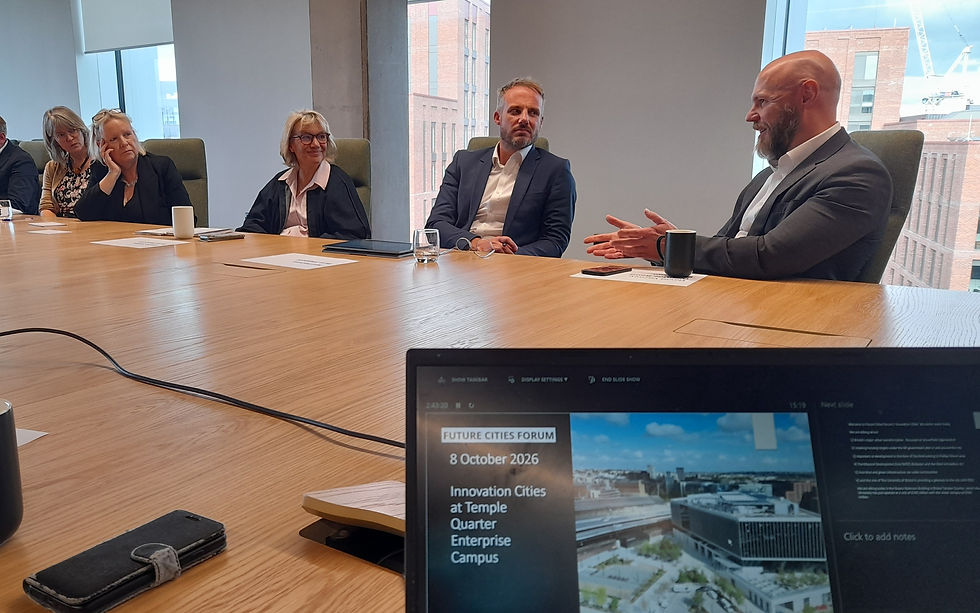
On the role of high technology and digital, David Varney, Partner, Womble Bond Dickinson gave the group a view on the value of the industry in Bristol for the future: The Womble Bond Dickinson team in Bristol is dedicated to building and strengthening ties with local markets in fintech, transport, planning and development - offering clients in-depth knowledge across a variety of sectors to help their businesses thrive. From the Bristol office, its team deploys transatlantic capabilities and significant industry experience to provide comprehensive and innovative legal solutions for clients.
David said:
'I think there's a lot to be said regarding innovation and skills and infrastructure, which is a big challenge at this point in Bristol. So part of my practice is advising early-stage high-risk tech companies, including some of the forty-six that the Provost mentioned as having come out of university over the past few years. There's a great scene in Bristol and the wider south-west region in terms of technology. I advise clients on AI, and cyber security. Bristol I think is quite well-placed to become an innovation, deep tech hub.
'There's four great universities in the wider region, churning out over 1,000 graduates a year, lots of investment in this part of the world as well. One of the perennial issues we see in our client base is the London thing, we're almost too close, I think we're different from Manchester, and we have that slightly closer connection, I think Manchester and London still are a bit of a long journey for me, so there's a bit of a brain drain occasionally.
In terms of what the region needs to foster innovation and growth, I agree it's people, housing, making the system more attractive and not losing people to London or across UK.'

Designing attractive mixed-use districts to support the growing population and attract international talent was question put to Tom Jackson, Development Director at Muse Places:
'It is a really good question and I'm pleased you asked that actually. On the topic of mixed use and of course it has been interesting listening to the University of Bristol earlier, talking about the mix of uses within the building and a lot of parallels actually around how a building can operate, how you can see this building working with kind of accidental encounters and things which don't really need to be close to each other being next to each other.
'That's what you do on the larger scale with master planning and urban planning and a proper mixed use master plan and so that really rang a bell and so in answer to the question the approach is that rich mix of uses which need to be put into what we can call it a master plan but essentially it's part of a city centre isn't it and I think here we've all got experiences of good and bad urban environments and things which are just a bit dull but then experiences of great things as well.
'I think more often than not so they are full of that creativity, that excitement, I guess, of a good diversity of uses and users and experiences. I mean, more specifically, I think someone, perhaps earlier on, mentioned the ground floor plane being the way in which people interact with master plans and urban environments. I spend a lot of my time looking at development appraisals and the big numbers are always the sixth floor office and 300 homes sitting above this, that and the other, but it's actually the ground floor bit might not generate a huge amount of pounds value, but in terms of the way people experience the development, that knock-on effect and value is a lot more significant. So there's a lot that can be done around ground floor uses and thinking about how that isn't just a Starbucks whatever you'd expect to see around a station, bringing in independents nda that real rich mix of uses can make a real difference.'
Tom was asked about putting cultural facilities into mixed-developments:
I mean again they're all parts of I think legitimate and great uses for city centre development aren't they? And yes there can be cultural uses, there can be other bits of social infrastructure and health facilities things like that. You know it's not, it's kind of easy to sort of talk about coffee shops and florists and bakeries and great though they are, I think there's a lot more besides that needs to be factored in. I mean look, viability is always a challenge, particularly at this stage, you know, when I'm looking at my That's something clearly we've got to keep in mind and obviously this is public land, there's an obligation there to get the value that's needed. So it's really that balance between mixing the uses, getting a good place but generating good revenue.'
'I think it's, one of the things that we find when we look at large scale master plans, that's what we use data science as our main focus, these are very long term projects, projects, they transcend decades in some cases, and you mentioned retail and I think we've all seen how retail has turned on its head quite a few times in recent years, hasn't it? From traditional town centre, city centre retail through to the out of town retail park and perhaps a bit of hauling out of city centres and then more recently online, how that's evolved and that sort of would easily sit within the timescale of a large scale master to find more of a development project.
'So I think the answer, it's not a simple one, but I think that there's something around flexibility that isn't there, just being able to react both in terms of the way we design buildings, in terms of the structures that we put in place with our contractual framework and partnering arrangements to be able to react to market demand for changes, quite significant changes in some instances.'

Student housing is also part of the mix at Temple Quarter and Andrew Brown, Associate Partner, Ridge, was asked whether design should improve to help the look of the city?
'That's a good question. Student housing has got that really unique ability to, you know, it's often part of the shop window when students often go to a place and live there, first time away from home don't they so first impressions mean everything and if we're throwing up substandard accommodation that doesn't that doesn't give a good first impression it doesn't last a test of time what's it saying about the wider city that it's in so I think we have to make sure that in whatever we do we present the best first impression the best public face that we can and that's why buildings like this provide a much better first impression than the old historical Royal Mail building that was here before.
'People come in and visit when they live here, whether they come for the day, they come in on the train, they see this here in this location, they can get a much better first impression than they would have done previously. I think student accommodation, it's really, we've got to really strike a fine balance in Bristol between quantity and quality. There's a risk that too much goes up too quickly and that it saturates the market, there's not enough demand and actually the quality is really low as well so we're kind of it's a lose-lose scenario.
'We need to make sure that where we do have student accommodation it's in the right locations to the best quality and really make sure therefore keeping those other pockets of land available for the other opportunities that need to come up and as funny enough Tom and I were talking outside just before we came in about trying to it's about striking that balance between within development zones what do we put where and how much and it's a bit of a crystal ball gazing scenario sometimes about how much do you need of each given use.
'I think you know it's on sort of a flexible that's that's absolutely what we need to try and design and it's flexibility to be adaptable in a similar way that this building is going to be flexible to adapt to the needs in future whether it's student accommodation that then could adapt to um to people who leave university but that's their first home in some form I think that's become more popular as well and in kind of cluster living, but it's about making sure that we can integrate key things about giving students and young people the flexibility to either stay within the student accommodation and grab a coffee or go to the gym or if they also give them the option to tap into the local infrastructure and go to another part of the city just as easily as it would be for them to go downstairs and go to the gym.
'So we need to make sure they feel connected but in a way that connects them to the wider city. If we can achieve that, I think we've got a really good ability to keep those people here. What we don't want to be doing is bringing them to one of the best universities in the UK.
'They're here for between three and five years and then they go off somewhere else because the employment opportunities are better somewhere else or the ability to live is just too expensive here. So we need to really strike that balance, give them flexibility and that comes down to actually around the table here we can come up with some great ideas but we need to make sure that the local planning authorities are really on board with that and can try and stay as agile to the needs as we think we need to be and that they're not a step behind as in some scenarios.
'I'm not saying that Bristol and BANES councils are necessarily worst offenders but planning departments can be a little bit of a step behind, can be a little bit cumbersome and we need to try and keep them along with the ride as well to make sure that we can and try and crystal ball gaze where we're heading and keep everyone aligned with that thinking as well.'

The discussion turned to the complexities of the planning system in the UK and whether this is putting off international investment. Jonathan Lambert, Director of Development in Savills' Bristol office, said that it is hard to get big companies to invest and that Bristol should start speaking with 'one voice':
'I think the frustration that I find, and have done so for ages, is that we talk about Brabazon, we talk about the office development at Long Ashton for Epic (*the US healthcare technoly company), which is just a mile away, that seems to be a really good cue for the city to worry about the South Gloucestershire boundary, the BANES boundary and the North Somerset boundary. It's a nonsense. When you think about it, it's fine politically in some of the more suburban areas, but when you think that as soon as you go halfway up the M32 you're not in Bristol. Of course you're in Bristol, that's how everybody thinks. Nobody who lives just north of Edinburgh will say they live in Bristol. It's different for people in Thornbury, or Weston, or Yatton, and BANES
' I think when Andy Burnham was the mayor of Greater Manchester, everyone thought he was the mayor of Manchester. A lot of people thought that, but he wasn't. He was the mayor of Greater Manchester, and that registered a brand. And we down here are still sort of fussing around, You know, going back 15 years about Cribbs and Broadmead being fought over for ages. And no one's really talking about it just being one area, whatever you want to call it. Bristol's got a good name, so has Bath. And everybody's just talking, sort of fussing over trying to make sure that we're pleasing everybody all the time.
'Whereas when you speak to international investors, they don't just talk about a toxic city and a region and the Bath effect as well. I think that's the biggest problem that we find for investors, because hardly anybody knows that, even when they buy a site, they don't realise it's actually not in Bristol, it's in a neighbouring authority. And that I think is the biggest issue we've got to sort out, is the 'sell' of the region. It's only 'Birmingham' actually, because that was Mayor Andrew Street, it was West Midlands, not Birmingham. So they're talking two big areas of the UK and we're all scrambling around seeing if we can get something for this little pocket.'
Jonathan was asked whether he thought cities like Manchester manage to get their voices heard more effectively?
'It's probably leadership where, you know, I think WECA is a big positive, but I think that, again, without John telling me off, I think it's just rebooted itself. I think now it's got a bit of an impetus behind it, not just because of the way the central government element is going, but I think it's got more about it, we've had it in charge, that's not a political statement, it just is, it's got more profile, whereas I think it was a sort of non-event in my view (before).
'I think we all have to work together, I think WECA has to be a success, if WECA's not a success I don't think any of this will be, to be blunt. I think the big problem we've got is that we've still got the parochial. WECA can say what it wants in terms of what it wants to try and do, but you've still got the planners in Bristol not wanting certain developments. How's it going to achieve that? I'm trying to say that in a flippant way because it's in the press half the time.
'You can't have a big vision and then you have elements stopping it. It goes against the whole devolution concept, doesn't it? If you devolve to WECA and then they can't do something because of a city council, same with a larger council, not getting something through because of a parish or town council, that's the issue we've got. But I think the main challenge is that it's come up three or four times, is this whole thing about affordability. It's not meant to be a controversial thing to say, but I think that we're not delivering any housing whatsoever in Bristol. .
'There won't be any housing delivered this decade, really, because even if you start tomorrow, it's going to take time. I think that we've got too obsessed with what affordable means. And we definitely need to provide affordable housing in the truest form. It's extremely difficult to do that in every single development. And what that means is that every scheme in the pipeline now is either a combination of affordable social housing and then very, very expensive housing to help plug the gap. There's nothing in the middle for all the people that are coming out of university, for all the people that make up the middle, the 80% of the population. We're already seeing problems with recruiting graduates, problems with retaining people. I think we've just got to try and build housing.
'I think with Manchester and Birmingham, They have city centres where you can build high-density houses very close to the city centre. We don't have that ability here. So we're an 80% flat delivery city, have been for 25 years. The country is about 80% houses. It's the other way around. We have to build in Bristol flats in a very difficult market. We don't have the ability like Manchester and Birmingham do to build houses walking distance of the core city.
'So we have to build houses. We've sometimes got to be careful that we don't have to fit everything on one site to the level you said earlier. I think this building is a really good example that can do it. But that doesn't mean you have to, every single planning application scheme has to be mixed use. If you look out the window, that's a million square feet of offices. I don't know where this is, over there. So arguably, we don't need to do offices straight away. We just need more people here to help sustain and get the cafes and everything else working. And you need to make this area a mixed-use area of the city.'
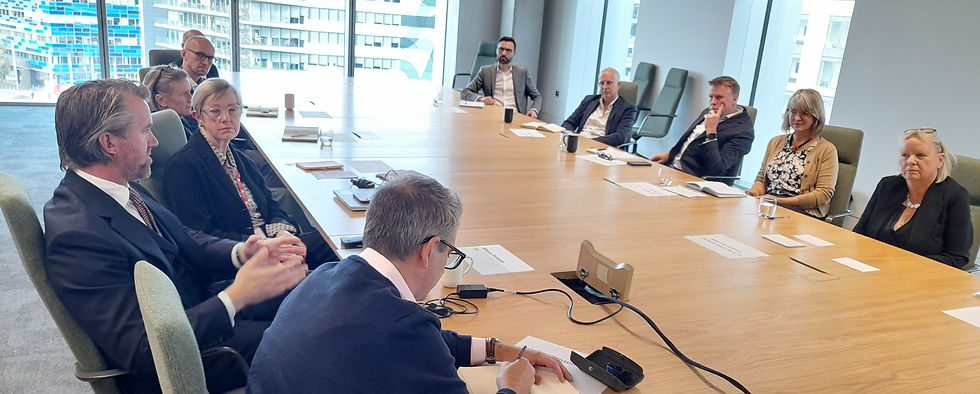
Marcus Richards, Partner in EY-Parthenon's Infrastructure Advisory Practice, brought the conversation back to innovation:
'I've reflected on everything I've heard this afternoon, which I think has been thoroughly engaging. I observe that one of the strongest attributes that investors look for is place regeneration. They want to be able to back places that benefit from a pipeline of ideas and talent and growth. And therefore I think we can see innovation as being something that unlocks all the regeneration that we see around us here. It can be a real catalyst for that.
'The sort of discourse I've seen of late recognises that innovation now is actually kind of core to a place strategy. I think that's probably emerged in recent times, and it recognises that it brings together these districts, we've used the term ecosystems, that combine talent and business and homes and communities into one.
'There is a growing recognition of the role of universities within that. I think that a world-class university, and I can say that because I'm an ex-Bristol student myself, is one of the strongest signals that a city can present to an investor. It demonstrates access to talent and research capability and long-term economic resilience as well. There's a real correlation between economic resilience and the strength of the university. And therefore I think that means, and Bristol is a prime example of this, the best cities don't just simply host a university, they completely integrate them into their growth and economic strategies.
'I think we've spoken about housing and skills, and again I think there is a growing momentum to recognise both of those as being key elements of economic growth. I was sat in a discussion with members of the CBI last week, reflecting on what devolution might mean to them, and there's this idea that skills policy is not really a social policy, it's an economic one now, and there's a really good metric that an individual around that table referenced that actually, when we talk about what we need for the economy of the future and how rapidly those are evolving, again, sitting here is a prime example of by 2030, 90% of the workforce today will be the workforce of 2030. It's not necessarily about new entrants into the workforce market, it's about how we re-skill and allow our communities of workforce to adapt.
'Two further reflections - I agree with the concept it's not solely about densification and with some of the work we've done with some of the new towns, we reflected back on some of the principles that underpinned the garden towns back in the post-war era. There was a wonderful metric that was put forward as they developed those, which we don't really speak about anymore, but I think we've touched on that today, that they were not necessarily about driving economic growth or numbers of houses, they wanted to achieve greater companionship between citizens. I think that's a wonderful measure for our places. How do we help them to create greater companionship? We need that now more than ever.
'If we think about what's required for longer term investment, again, we've spoken about that today. We don't really have a challenge in this country about lack of strategy, there's plenty of strategies that are developed up and down the country. It's about the long term vision and delivery structures that can ultimately, I think, supersede political cycles and have the longevity that's required to develop a place. I was in conversation with a gentleman called Nabil Khan, who some of you are familiar with. He's the Chief Executive of the Oxford Street Development Corporation, and he referenced a wonderful perspective around the King's Cross master plan and the regeneration had done there. But when that was first conceived, Google was being run out of the garage in San Francisco, and so there was no way they could have conceived that those sort of businesses were going to be selling takeover of their master plan.

'I think that we're right not to do the geographical comparison with Manchester, maybe we need to look at the North to the West. I think there's a chronological perspective we can take because if we're looking for lessons we can learn from the Victorian era and the kind of great era that heralded such civic development and pride of place What was recognised so effectively back then was that it couldn't be delivered just by the public sector, by the private sector, it had to be delivered in partnership and obviously again I'm going to make my link back to Bristol, I think there's probably no better caricature of that than Brunel himself. he understood that ultimately success and prosperity came from that partnership of engineering, entrepreneurship, infrastructure and economic growth. I think this cycle we're on here is a prime representation of something that ultimately I think probably stood the test years ago. There's a huge amount we can learn from that.'.
Marcus was asked to comment on whether he detected a sense of frustration from the UK government over the resistance of private companies to join in a private/public arrangements to support new infrastructure and what measures could be brought in to unlock it?
'Well I think the principle of devolution is a prime cause to be able to achieve that more effectively. I'm sure government, and if we talk about that from a central Government perspective, is frustrated about the pace and quantity of private investment that flows into areas. I think central Government probably has a role to play in why that is the case and I think that actually what they need to do is have trust and confidence in their local areas to develop the sort of strategies and innovations such as the Future Places Fund, that you referred to, that aren't then sort of suffocated by central Government oversight. Give local places the trust and the confidence to go and make their own decisions and as we've spoken about, make personal decisions around its own vision.
'I think some of the greatest, it is regrettably Manchester for example, but it's one I was involved in, of private capital and support of the Victoria North New Town, that really wasn't founded on something decided on a spreadsheet, it was decided on the fact that they were brought in and some of the vision and trust and confidence they had in the leadership of that area, which is really important, from the City Council.
'So I think demolition is the answer to that, I think have the confidence to let local areas engage in investment without the sort of suffocation that sometimes central Government can apply to that.'

Claire Wilks, LDA Design added:
'I mentioned earlier the importance of early delivery of active travel combined with green infrastructure links and the Bath River Line as an example. The Temple Quarter masterplan came to the Design Review Panel which I was on and something I picked up which was really fascinating was your proposals for the green platform. Please nod if that's still in the proposals. But that runs along the Brunel Mile which is connecting the Temple Meads all the way through the city as far as the suspension bridge and that seems to me an amazing opportunity for early delivery which introduces this idea of fantastic placemaking as increasing values, as I think there's quite a lot of evidence to say that that does happen, because it can be active travel. It can also be planting, it can deliver activities, meanwhile uses, test spaces etc and it can be that interface between the buildings as they come forward and you have these seven sites also around and it stitches together the old and new and it connects the kind of mosaic of the community and also the opportunity to tap into the Avon 2100 project and ultimately goes towards multiple benefits and it seems an interesting concept and reminded me of the Goods Line in Sydney.'
John Wilkinson responded:
'There are really significant challenges in Bristol around building stuff at the moment but I do think we've got to start doing ourselves down. I think nobody would dispute that I think the first decade of the colonial authority hasn't been the best that we could have been but I do think things have fundamentally changed and I think we need to start to tell that story and I agree with you on that again but I don't think we can't keep telling a story of how for the last ten years we've been a bit crap. We've got to start to say actually there's something really extraordinary going on in We're a highly productive region. South Gloucester, I think we've trod this out a lot, I know that there's a truth in it, is that we're a London borough. You can say it's the most productive London borough. We've got a highly skilled workforce in our region that is the envy of a lot of other places. We're a net contributor to UK TLC. Most other regions, Manchester included, is not.
'We've got £2 billion investment from YTL, a major international investor, coming into our region to build a phenomenal new town with a 20,000 seat arena. They're doing that because they think this is a great place and because of the investments that they've made before. We've got politics that actually is working incredibly well and again is the envy of many other regions. We've had five or six committees since Helen was elected and I think I can say every single paper that's been taken to that committee has been approved unanimously. We've got politics that's working well and we've got a mayor that wants to take all of the things that are on offer from government and make the most of them for the region. If she were here now, she would be saying we've got to get over ourselves. Actually no, I will use the word Manchester once. We've got to have a bit of their ambition and in some ways aggression to actually put the West of England on the map in a way that it hasn't been before.
'I don't disagree with the challenges but I actually think we've got a far, far better story to tell and are beginning to tell it and are being noticed in government in a way that we've never had before. I think all of us around the table that are interested in delivering in the West of England need to start telling that story consistently. We have a growth strategy. It's not right to say that we don't have a vision for the West of England. We have a growth strategy which we're now translating into planning through the SDS. Again, we've got to start saying actually we do have a vision. It's called the growth strategy. It might still be called the West of England and not Bristol and Bath but I don't think there's much of an appetite for us to grapple with that at the moment. I just think we need to pick ourselves up, not carry on doing ourselves down because that's not going to get us anywhere.
Comments