


Future Cities Forum's 'New Model Innovation Districts' - report part one
Updated: Jul 10

Future Cities Forum was delighted to be hosted by the Wellcome Genome Campus last week for its 'New Model Innovation Districts' discussion event with CEO Robert Evans making the opening speech. Robert was joined on the first panel by Jane Hutchings, Director, Cambridge Science Park, Roz Bird, CEO, Anglia Innovation Partnership for Norwich Research Park, Vicky Stanbury, Executive Director Business Innovation & Operations, Imperial War Museums for IWM Duxford, and Fred Pilbrow, Founding Partner, Pilbrow & Partners
The event looked on how science parks and innovation districts are developing in the UK and future impact of the newly created Greater Cambridge Development Corporation on the planning and infrastructure of the region.
Forum Co-founder and facilitator, Heather Fearfield, introduced Robert who began by describing the Campus as ' a powerhouse for a particular type of science to do with genomics and 'omics', biodata and - increasingly - AI, with a really concentrated hub of talent in that area. With a very strong academic bias, a growing business element to it and an important community aspect to the place as well.'
'We are growing pretty quickly. That's the plan, certainly. Campus today is pretty leafy and pretty low density and very countryside-y, as you would have seen if you haven't been here before. But as you arrive, you'll have spotted that. But there are a mixture of buildings. There's the conference centre that you're in. There's a listed building, Hinxton Hall. There are slightly more modern-looking buildings behind that. There are obviously wet labs, dry labs, all the usual things that you would expect to see. And the main occupier is listed on the top. There's the powerhouse of genomics. There's the Wellcome Sanger Institute and EMBL, the European Molecular Biology Laboratory.. This is really the bedrock, globally, of open-access bio-data.

'Coming soon, the third of those, which we're very excited about, is HDRS, which stands for Health Data Research Service. HDRS is a government and Wellcome-joint initiative to create a new way of unlocking patient and health data. And then using that with other data, which we're very strong on here, and using that for research and clinical purposes to drive further advances. There's a mixture of building types.
'One of the newer buildings is Thornton. But it is very much a kind of campus style, with buildings in the landscape, and including some of the remnants of the former Hinxton Hall estate, and the former East Lodge. In terms of the science journey, we are trying to turn this, our plan really is to turn this into much more of a kind of whole place - and into an innovation district. And that's as much about the public realm as it is about the buildings. And that's a bit of a change for this place. One of the things that we need to do over time is bring more density and intensity to this place, because that's how we create more space and forums for collaboration. That's obviously a little bit of a challenge, but it's something that we'll do over time, both in terms of how we modify this side of the road, and how we develop the other side of the road, where the expansion is. It's a very big expansion. We're more than trebling the campus overall.
'We do think it's a very significant project, particularly in that strand of omics and data and AI. And the people that work here, the scientists, do have an important, trusted global leadership role in their particular areas of science. We think that the project here strengthens Cambridge generally, not just strengthening the Genome Campus.
'The expansion takes us to 440 acres, but Wellcome actually happens to own 1,000 acres here. So there is more land available to support this place if it's needed over time. We're trebling the amount of laboratories and workspace. We're adding, for the first time, a significant quantity of homes as we turn this campus into a place. And that's a really big change for this place. We're adding new compute (infrastructure), because that's a growing part of what we do here. But also all the things that real places need, health and fitness, sport and play, nurseries, hotels, food and drink, etc.
'That requires huge amounts of infrastructure, which we haven't put in from scratch. So there's a huge emphasis on new bridges over the road, what's called micro-grid power and ambient loop systems. It's all costing a lot of money, as you can imagine. And at the end, that last point, removing the gates and barriers. This is currently a gated workplace, really. We want to turn it into an open place for everyone, with obviously a real clear science purpose. But we are, as part of the plan, taking away the gates and barriers and opening the whole place up. And the expansion land will be completely open. Of course, the buildings can lock, but the whole point is that the place itself is open to everyone. The facilities and services will be open to everyone, locally and within Greater Cambridge.

'And that's the vision for the place going forward. The first stage opens in 2028, so not long now. The ground floors will start to look more animated in a way that you might expect to see in towns and cities, which isn't the case on the campus today. So that's a fairly traditional way of getting the building to express itself to the ground floor and animate the public realm, which will be familiar to many of you. Some early renders of the new homes, which will be quite distinctive. And they'll all be for rent initially and owned by Wellcome with a new major health and fitness club for campus residents and workers, but also other members, which we're going to operate with Nuffield Health, and we're very proud to be working with them.

Robert continued:
'These are some of the bridges that are going to be quite distinctive features, which get lifted into place come October. So it's going to be quite a dramatic moment when the bridges get lifted into place. We very much hope they fit. I'm sure they will.
'We're building a thing called an energy farm, which is a posh way of saying an energy centre. We're calling it an energy farm because I'm very keen that this fits into the landscape. And we are, in a sense, an agricultural landscape. So this has been designed to resemble a collection of agricultural buildings. But it's also a disaggregated energy centre, so all the bits are on show. And there's a public engagement element to this. We want this to be a place where people come and visit and understand how urban infrastructure works. So we've designed it that way. And that's actually a live planning application at the moment. And it's the heart, really, of this system, which is a district heating system that we're putting in across, with borehole arrays and ground and air source heat pumps, and other things that are inordinately expensive, and a microgrid, which is a way of generating our own power from photovoltaics and other sources, and then storing it in batteries, and then using it when we need it.
'But also we have a grid connection, too, as needed. Very quickly, we're investing in social infrastructure, which is something we need to do to become a real place. And we're fiddling with the campus. So the campus where you are, the left-hand side needs to change. And I won't go over what we're changing, but this isn't the campus as it appears today. This is an interpretation of a future version, with new entrances, new buildings, some more intensification and some changes, to try and create that matching left-hand side, to really complement what's emerging on the right-hand side. And much of that really comes to creating what Allies & Morrison, who we're working with, called a 'clear chassis'. So it's how do we keep the place going, allow the current science to continue, but slightly modify the place over time, and bring the two halves together, with clear public spaces and clear routes.
'At the moment, those of you who came here this morning by car, it's probably pretty easy to drive and park, but actually if you walked around the campus, the place is actually weirdly car-dominated, even though there's 1,000 acres and there aren't that many cars here. But the roads are quite wide, the pavements are quite narrow, actually it's going the wrong way. We need to subvert that and make this a place where the pedestrian is king and the cars are tucked around the back, by and large.
'So I think our aspirations are recognised a little bit in the local plan, a bit like a plan on a journey, and we'll see what happens next, but this talks about us developing as a place, the famous jobs and services, and over the period and beyond, developing as well as a settlement. I'm an geography graduate, so I recognise the word settlement, it's a lovely word, isn't it? And I would be bolder, obviously, because I'm the Chief Executive here, I'd say we should be a town. That's quite a controversial statement with many, because to many it just implies size and growth. I think of it more really as a state of mind. To me, town is more about the types of spaces, the types of density and intensity, the types of goods and services. And the way we fund those goods and services so they're viable over time, most things here today are actually subsidised by Wellcome, but that needs to change, and we need to be bigger to really sustain that. But it's also how we make sure that we get other infrastructure that Wellcome can't do on its own.
'All the things like I mentioned, the microgrid and the ambient loop, we can do those on our own. What we can't do on our own is transport. So being a little bit bigger, being a town, whatever that ends up meaning, and it's not really down to us, it'll be down to others to decide that over time, but it'll probably help us track this as well, which is our biggest challenge, which is how do we become part of the transport map, the public transport map of Cambridge? We are on the draft interim plan that emerged the other day, but we're in the slow boat of 2045, and that's something we're seeking to change. And I think actually there's probably a growth designation, civic designation and transport investment story that actually should be complementary.
'In the meantime, we're doing a big study to look at how we might generate our own autonomous vehicle link, which is the parkway. That's really our interim measure, because we can't wait. But we'd much rather work with everybody to get genuinely public transport here for the benefit of everyone, local people, but of course our campus workers and residents and visitors too. We have started. This is the picture of a cake with the master plan on it. This is the first time, and I think Allies & Morrison tweeted, this is the first time they've ever been involved in 'place baking'! It looks like we are building South Mimms (by the M25), but we're not, I promise you! But it shows you the scale of what we're doing, just from the first phase, relative to the size of the current campus.'

After Robert's speech, Heather asked him whether Wellcome was looking for government support in terms of funding? Robert responded:
'So at the moment, everything we're doing, we've been able to pay for. I think that's just the reality of modern development, in many respects. And I think that's what we need to do. The shift, the burden of infrastructure has, over the last few decades, shifted a lot towards effectively, the land owner and that's just a fact of life. I mean, the project is a commercial investment, by and large. So Wellcome is a £40bn global charity, and it has two halves to it. It has an investment arm, and it has a mission arm (funding medical research). The investment arm invests that £40bn to make, I don't know, three, four, five billion a year. And guess what? The mission side spends 3, 4 or 5 billion pounds a year on the research programmes. And that's the way that the charity remains alive, and hopefully continues into the future. And we're an interesting mix.
'So we are - the company I lead - we are an investment master-planner. So our job is to make money. We're not doing this out of sheer optimism. So that we can give it to the mission side, to spend on the amazing things that Wellcome has done and can do. And as it happens, we host some quite important donors of mission such as the Wellcome Sanger Institute, which is Wellcome funded.
So we're an investment project that needs to make money, but ultimately it's still a project. So this project has to make a return, but we have the normal rules of making a return. We happen to be fully equity funded. But it's going to be a challenge, yes, it's going to be a real challenge. The thing that we want public help from is on the crosswalk. I don't think I am looking for anyone to come and give money to the Light Railway, or the Energy Fund, or whatever. Although we are talking to some green heat networks, there is a government funding for green heat networks, and things like that.
Robert was asked whether he felt the current infrastructure plans were adequate moving forward? He replied:
'Well at the moment we're spending a lot of money on buses, and people are trying, seeing if you support cycling, car sharing, and things like that. We will support all of that, and we will continue to run the campus buses, and the coaches that we need to do.......but really, the cycling is an area that needs to be focused on. And we will work with anybody to do that. ....I want to go back to the growth community, to work out the pattern of the buses that we want to support, and how that can be supported. I think one of the problems with our system is that if a project has already gone out on a charity mission, it's sort of seen by civil servants and others as what would be happening. We sort of tick the box and go, that's what would be happening. And they look for additionality, which means, if I put some money into transport, how can I generate more homes, and more jobs can come? But we also have to deliver properly the ones we already have. There are a lot of people investing a lot of money here.. But I think that does depend on the cost.'
Robert was asked to comment on the impact of the developments on the historic village of Hinxton next to the campus:
'It's a conversation that needs to continue. I think the campus has been a little bit insular. Mentally, in terms of its approach. There have been good links. There are events. There are things like annual fireworks events and other events. But it has been, essentially, it's like a campus. It's locked. That's partly because people didn't want cars to go there. That all needs to change. The extent that people are in restaurants and shops and services like health services, they need to be welcomed and used. They need to be positively encouraged. And to go into similar interests, that does need to shift. We need to work with the council here to create that sense of the civic and it being part of the civic map. I think a lot of the negative aspects around the original application has gone on. I sense a pretty destructive desire to work on that. I think it's important we make sure Hinxton thrives alongside this growth.'

Wellcome Genome Campus was joined on the first panel discussion on 'New Model Innovation Districts' by Jane Hutchins of Cambridge Science Park, Vicky Stanbury, Imperial War Museums for IWM Duxford, Roz Bird of Norwich Research Park and Fred Pilbrow of architects Pilbrow and Partners.
Cambridge Science Park is hoping to gain permission to triple the size of its footprint, encouraging more start-ups and innovation companies to take space. Jane Hutchins, Director of Cambridge Science Park commented first on an aerial photograph of the park taken two years previously:
'The right-hand side was the original face which is now one of a very large cluster of parks in and around Cambridge. That has been redeveloped. It's fair to say that the buildings there which are shiny, futuristic, very modern buildings, large buildings, they've replaced a series of 22 mostly single-storey sheds put up in the spirit of experimentation by the Science Park Management and the Trinity College who own the park. They put up a building for it. When they started it was a little bit piecemeal. You can still see some of the original buildings there. They're very squat. There is amazing science going on with those. Don't be deceived. We've got a little over 2 million square feet built off this and that.
'The master plan that we submitted about a month ago is looking to expand that to about 8 million over the next 30 to 50 years. It's very ambitious. We will not expand the boundaries. Unlike the project here which is wonderfully going across the road and really creating a significant presence here we're planning on going up rather than out on densifying what we have preserving and enhancing the existing very biodiverse green spaces. That brings its own challenge in terms of biodiversity net gain because it's pretty good to start with but basically building on a lot of this we've got a lot of flat 1980s style car parking which we don't want to maintain at all.'
'So more of our surface area on our estate is flat car parking than anything else. So our proposal in the last plan is to bring in four multi-storey transport hubs so you can accommodate cars, EV charging, bikes, shower rooms, maybe even coffee in there. Put the cars to the periphery, so a lot of what Robert was saying resonated very strongly with us. Put the cars to the periphery to make it a much better environment for pedestrians and cyclists and we already have somewhere around 37% of people coming by bike. So again, because we're urban, we have a different travel picture but we need to enhance that to make it easier and better. I speak as someone who cycles, so not to work anymore, but I cycle around Cambridge a lot.. So that's basically the bones of the master plan.

Heritage and science parks
'In terms of heritage, I think it's important. I think the greatest bit of heritage in terms of 1970s architecture that we have is at the very top of this image, which is known locally as the Toast Rack. It's a fantastic concrete forward-looking building. I mean, you never do this nowadays, with a concrete exoskeleton. It's a true landmark for the enhancement of the A14, the trunk road that runs over the top. That was the one bit of the science park. In fact, it probably still is the one bit of the science park that everyone recognises. You turn off the A14 at the Toast Rack. It's the most fabulous building. You walk up to it now, it has a reflecting pool around it, which has a practical function as well as an aesthetic function. And it looks like something out of Thunderbirds.
'The master plan isn't being prescriptive about the architecture. It's setting the design code for the architecture. How high can we go? How dense can we go? What are the standards that we're aspiring for? I think, again, we're backed fundamentally by a charity, Trinity College of Cambridge. We're owned by the endowment, which is... The purpose of that endowment fund is to fund the activities of the college. That was set up in 1546 when the college was founded. And this land came as part of that endowment. So, again, we have a very, very long history of this virtuous circle of the endowment investing in the park, the park generating revenue. We are run as a commercial return.
'We don't have government money coming in at all. We're now so big and valuable that we operate with partners in schemes like joint ventures and so forth. But there is still this circularity of making money in order to fund college, which also supports a lot of the University of Cambridge activities. It's not just about Trinity. But to continue to do that for the benefit of all. So, again, unlike Wellcome, we've never had a front gate. We don't have a big security desk to come through. It's an urban site. It's an urban site where, you know, I meet people who are well advanced in their careers who say, well, I'd like to borrow a blade on the science park because I could walk in. You know, it is genuinely integrated. But we could do so much better. And the master plan envisages that.

'This is a vision of the future. Some people who've seen it say, I don't like the architecture. It's very blocky. It's not meant to be looking exactly like this. This is a concept of what densification means. So, you can see it's still very green. You've still got lots of trees in the green spaces. But we have a lot more buildings. The roads are far less prominent. The aim is to reduce. We have a public highway loop road inside the park. At the moment, it's a two-way road with a 30 mile an hour speed limit. That's not comfortable for anybody. It's too fast for drivers. It's not comfortable for the pedestrians and cyclists on the not exactly continuous cycle tracks that run around the park. It needs to be improved. The world has moved. We've moved on over those 70 years.'
Tall towers
Jane was asked whether the important notion of densification meant tall towers?
'Not towers per se. So, at the moment, the largest buildings we have are these ones at the main front entrance, which are about four storeys tall. I think the maximum we're going through in the master plan is eight changes. Potential for that, yes. Yeah, potential. But we're very strictly controlling that. We're strictly controlling the height. So, on this side, you can see we've got dense residential. This is Kings Hedges, which is already here. It's an established residential area. So, you'll notice, if you look carefully, the buildings on this side are only four storeys high. That's because the people living here absolutely do not want to have a wall of modern architecture facing them. If you remember Greater London, when the height control was lifted, you'd drive out of London and you'd hit Croydon. So at Croydon we've got tall towers, massive, massive towers. That's what we're avoiding. We're lifting up towards the middle, so the height will come in the middle. And we also want to introduce key landmark buildings with exemplary architecture, really aspirational in their design, to help navigate.
'I'm going to try and upset some architects and get a conversation going. I don't know if there's a few in the room. But I think when you have a place this big, the brand can be the place. You don't have to rely on the architecture to have 'brand' buildings.. In real cities, you have market buildings, like you're talking about. But you also have other buildings that are just tucking behind in great streets and spaces. And I don't think everything has to be about, look at me, architecture. In fact, I think if you have too much of that, it can actually be a bit odd.
'So, we were talking with a couple of occupiers in our remaining single-storey bungalows. And they're quite nervous because they've seen the master plan and said, well, are you going to kick us out? Basically, as long as they want to rent it, we will enable them to rent it. Because we're about growth. We're about bringing on new businesses, not just looking for global headquarters, like the City of London said. We want to bring that pipeline through. It's in our interests to grow our own businesses. But it's also in the interests of the economy, the UK economy, to get that growth coming through. In the early stages, they can't afford big flash borders. And they shouldn't. They should be investing in the R&D, in growing the team, in growing the product, in improving the concept, not on very high rents. So, we need that pipeline. And the older buildings very much serve our purpose.

Transport connectivity and North Cambridge
Jane was then asked to comment on the need for better transport connectivity? She said:
'Transport is critical for us, for our future growth. We are well connected. We also have the benefit of Cambridge North Station. I think we can enhance the journey to encourage more people to come by train. You know, as a former London commuter, I don't bat an eyelid about walking from the station to the Science Park. But it's a boring walk. It's really unattractive. And I think when it's boring, people feel threatened sometimes. They feel exposed. There's nothing to look at. You're just going down this path. And it's a wide path. It's great to cycle on. But it makes you feel you're going further than you are. Not brilliant at night, I guess. Safety-wise? It depends how confident you are. So, there's stuff we can do. And we're actually collaborating with local landowners, such as the Crown Estate at the Cambridge Business Park, and St John's College, with the St John's Innovation Centre nearby. We're all within five minutes' walk from each other. And we all share those concerns. And we're working together to see what we can do to lift the area. But no transport is critical.
A question was then put to Jane about the 20,000 new highly skilled jobs coming along:
'I mean, the ambition for growth is real. I think it's really positive. It's such a statement of confidence in the future of Cambridge and the UK that we can say, look, we're going to back this. Trinity have already said they will commit a billion pounds to the redevelopment and to delivering the master plan, which is astonishing. People are excited. I think because we've been there so long, so many people in and around Cambridge have grown up with Science Park as part of their lives. Their family members have worked there. They've delivered fruit there. They've worked in labs there. Whatever it is they've done, it's part of their lives. So we are quite integrated socially. And we're very excited about seeing more of that.

Aviation technology and Duxford
The Imperial War Museum (IWM) is developing a new aviation technology innovation centre at the Duxford Airfield and Museum and Vicky Stanbury, IWM's Director for Business Innovation and Operations, was asked next about the development which sits by a neighbouring village to Hinxton:
'Well, we've actually got two developments happening which are connected. So on the IWM site, on the Visitor Attraction site, we've got plans for a new building which will be a conservation, storage, and apprenticeship facility. So that will store our largest objects, the aircraft, the tanks. And there's a critical need for that in Duxford. And then to the west of that, we're joining forces with our neighbour, the land-owner Gonville & Caius College of Cambridge University, to create a campus, and we've just appointed HBD, that will support low carbon Cambridge. And that then takes the heritage of IWM Duxford and our conservation engineering background together with the deep experience of the University of Cambridge and the Whittle Lab to create that kind of innovative campus. But uniquely, it will also have access to our airfield. So for those of you who don't know Duxford, we have a working airfield.

'Part of the USP for Duxford is that you can go and see a Spitfire flying and it supports heritage flying and so the new campus will have access to the airfield, all the infrastructure of the campus from the airfield because it's a CAA licensed airfield so it has full fire cover and it will be licensed for those people who may be start-ups now but will need to fly in the future or test for a different purpose.
'Obviously, heritage is our lifeblood and creating a sense of place and a cultural soul is our lifeblood. And I mean, IWM Duxford is a wonderful visitor attraction and has a sense of place because it's a well-preserved, well-curated air base. So heritage and sense of place already runs through that and we have a strong relationship. We are very close to our surrounding neighbours and we welcome them onto site and a lot of them volunteer for us. We're very lucky at the moment.
'So the conservation storage facility which we call The Lab is part of a much wider master plan at Duxford and both The Lab and Duxford AvTech and that wider master plan are really critical to securing our future as a visitor attraction. We're full at the moment so we do not currently have the capacity to move our aircraft around, to suspend them from the ceilings when we need to create the best visitor experience that we can or indeed because Duxford houses our country's aircraft collection to keep collecting for unique aircraft as they arise. And so all of that opens that up and hopefully secures our future and creates a visitor experience for the broader audience.

Vicky continued:
'The right environment is really challenging. Moving historic planes around is incredibly, incredibly expensive and incredibly challenging. So we've just finished a project where it's the most technologically challenging project we've done - and Jo Saunders' team, because we're so full, are trying to move aircraft wherever they can to try and create a better future for Duxford. And it's incredibly difficult to get them into a shape for movement, to keep them conserved, to move them around and all of that costs money and also potentially damages the collections.
Jo Saunders, Head of Master=planning at IWM commented on the transport issues at Duxford:
'So with the transport issue that we have, one of the things that we are frustrated about in terms of growing ourselves as a visitor offer, as the second largest visitor attraction in the eastern region, only behind the FitzWilliam, is that you have to have a car to get to us. So we're a few miles from Whittlesford, but the station doesn't have a bus turning point, so even if we were to put on a shuttle bus, we can't turn around at the station. The walk is 40 minutes, if you're going relatively fast; Vicky does it, that's what I'm looking at, and you've got to cross the M11 slip roads, and there is no public bus, so we can't get more visitors to us without adding car parking, which is something none of us want to spend money on, and we don't have the money to do that. So we've got a site that could attract 600,000 visitors a year, and we currently do just under 300,000. We've got the capacity on the site to accommodate thousands of people a day, but we just can't get them there. So it's a conversation that we want to have with anyone who's happy to talk to us about how we can improve that.
Vicky added:
'And you asked about the attractions or coming to work for us, it's the same issue, because people, particularly young people, can't get to us. So it's, so recruitment as well is going to be different.'
Harry Bunbury, Development Partner at HBD joined the conversation to further explain the future of the AvTech project at Duxford:
'Duxford in its totality is sort of a non-lab bit, which is very much an IWM project. We are 425,000 square foot in total coming forward. We are the development partner with Gonville & Caius College, and we all think with the Whittle Laboratory, the University of Cambridge. Duxford, aviation, heritage, history, what better place to reinvent aviation than here? That is what we're bringing forward. That is the ecosystem. That is the innovation centre which we are wanting to deliver. What does the future look like? Well, we asked our CGI folk to come up with some good ideas. We don't know at this stage. None of us know what it looks like. But with research and development, Cambridge and Duxford, it is a great leap for us as a business to go into this sector. But, if you common sense it and you think about it, it is a great leap for us as a business to go into this sector. But, if you common sense it and you think about it, you know, if you common sense it, I always say someone like Jeff Bezos is going to be wanting to fly to his yacht somewhere in the world and he probably doesn't want to share a vehicle with everyone in this room. He wants to go on his own. We need that invention. We need that revolution and that sector's advanced air mobility. That is what we will be focusing on. Our single biggest challenge is both on-site and off-site infrastructure which we are paying for. At an off-site meeting myself and colleagues at IWM we've told the parish councillors about this and they are really supportive.'

Investment, manufacturing and agriculture
Roz Bird, Chief Executive of Norwich Science Park, joined the conversation to describe the future for science superclusters and manufacturing:
'I'm from Cambridge. but wasn't quite on Jane's avenue but not far from there and I used to run the Cambridge cluster and then when we sold Grosvenor Park. I moved to Silverstone and started working there and I was involved championing the Supercluster idea. The reason I called it 'Supercluster' was because of all the cluster organisations across that geography, and I saw the opportunity beyond the infrastructure, which I'm sure is fine, the universities looking up and doing what they want to do, and being those high-tech cluster managers with knowledge of and connections with all of the great businesses across the geography, helping them to meet with each other. And I always used to say, you know, if you can't solve the world's problems across that geography, where in the world can you do it?
'I think that there's every chance with all of the things that are going on, that it isn't about just the infrastructure and just the places, it is about the connections between people. I think everybody that's created in places like this has the convening power, and so that means you can bring lots of people together, and if you structure it right, you can get lots out of those conversations. But that's where the growth of the economy will come from encouraging people to work with each other. And the bit I love in my job more than anything else is when I can get two people in a room that otherwise would never meet and help them to talk to each other and see what could come from that immediately or in the future. In the kind of science park world, and I'm on the board of the Science Park Association with Jane, we call that engineer serendipity.
'So the more we can engineer serendipity, the more we're dealing with good jobs. So in that context, I went to Norwich, and I went to Norwich because I'm from the area, from the town here, and I could see it had some major fundamental assets like skills and technology platforms, investment from government on one campus, but I was looking why isn't it flourishing, what does it need? And frankly, in my interview I was saying this earlier, I did say a few times forget Cambridge, and so people stopped me and said you've said that a few times, what do you mean? And I said well look, if you want to pitch Norwich as the cheap space down the road from an obesity market, it was four years ago, then you'd have to meet me. But if you think this place has something to offer, if it serves some very interesting and large global markets, if it's got some USPs, then that's the bit that I want to look at.
'And long story short, Norwich is doing different science to Cambridge. It is all life science, because life is all life, including wheat, animals and people. But with this overused term, people tend to think of drug discovery, therapeutics. So we talk about engineering and biology, and I specifically from a commercial mindset talk about global agri-biotech, food biotech and industrial biotech markets. So I went to Norwich because there's 30,000 people on site every day, including the patients, because it's one of the largest research clusters in Europe, and because I'm a CEO with a chance to do marketing and a chance to spend it, placemaking is all about people in a place. So I thought I could come in and add to it.
'So I'm the Chief Executive of the campus management company, and actually the previous chief execs are generally scientists. So a few people said to me, that's interesting, we've never had a non-scientist do it before. And I said, well I hope there's a few good scientists here already. And so when people say to me, I love what you've done over the last four years, the buzz is, I've done a new science. So you need all of it, you need the science, you need the facilities, but you also need the marketing. So I think the main difference between Norwich and Cambridge at the moment is a couple of decades of marketing, but I'm doing my best to catch up. And I don't think what we're doing in Norwich is to the detriment of Cambridge, by the way. It's different science, and we need to put ourselves on the map.
'The joining up of the two will come eventually, but we've suffered from being overshadowed by, and the last thing we want is someone to say, oh, Norwich is now successful because Cambridge has come in and helped. Now it's linked up with Cambridge, it's been doing all right, but actually we need Norwich to deliver for the investment of the next generation infrastructure, which is a £400 million government investment. The John Innes Centre, world famous, you know, we have the Norwich General Medical Hospital. I was thinking -is it accessible? And I was thinking, I wonder how many people were born on my campus that live in Norfolk? Most of them would be. I'm going to get that figure, because obviously people move in, but you know, a lot of people are born on campus and live in the big area.
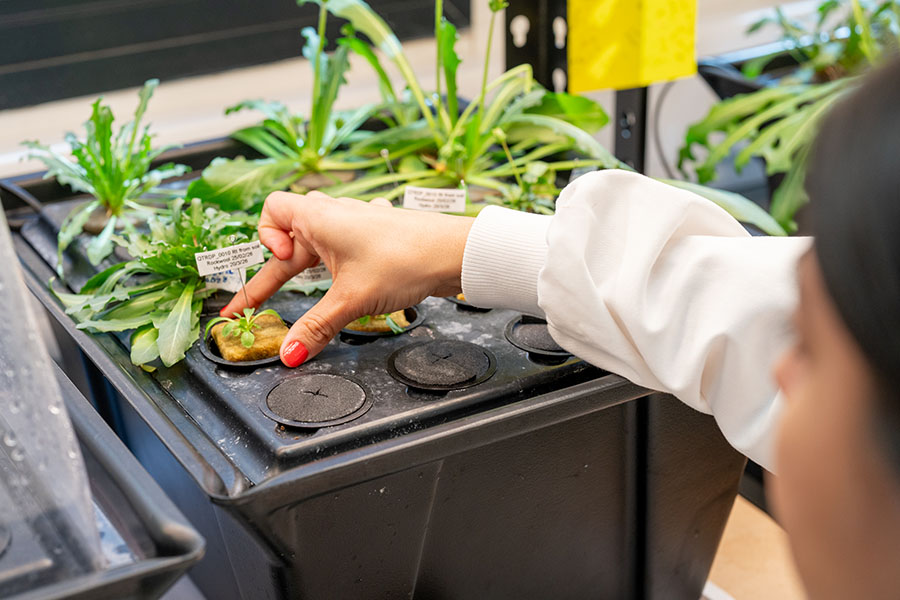
Roz was asked the all-important question about provision for manufacturing in the region to help support the park. She said:
'It depends on the markets that you're serving. So we tend to think globally. The facilities that our markets require are the next stage on from these, we've got a lot of academic research facilities there. There's obviously other animals, one I'm talking about, probably six really, okay, and that's within the microbiology, lots of microbiologists, more than 100 groups, going from agriculture, food, nutrition, health, into the environment, right? And the next stage, the companies that are coming to the campus, we've got about 50 there already, and then we've got one and a half billion square feet, and we want to grow the ecosystem. They're accessing the technology platforms that the scientists are using, right?
'So that's one of the reasons they come, and that might be horticulture, or it could be mass-based. And don't forget that we do go into medical, because we're looking at gut health, and nutrition, and food, but we're not manufacturing pills, like we're not going through a test run. So the next set of facilities that are required in the global markets we serve, in agri-food and industrial biotech, is scale-up facilities. That's the next step for us, and we can have some of those at the campus. That's more large-scale fermentation facilities, a high-production plant for novel foods, that sort of thing, and that's going to come.
'So yes, you do need all of that to retain companies, but as much as that, you need to think, well, for example, Tropic, one of our most successful companies, four people from Tel Aviv, camped out in a dining centre, 10 years later, over 150 people, and they've just raised their second lot of 100 million. They're producing bananas, and I did say to them at the BBC on Sunday that, you know, we can't have banana plantations in this country. Now, we do actually grow more banana seedlings than anywhere else in the country, at Military Research Park, yeah, and then they get exported to Guatemala places. And the same with Colorifics, I should say. Colorifics, that were shortlisted for the Earth Shot Prize, they've done some cool stuff with fermentation to change the way that the fashion industry does cloth, producing that water that you need, and they're using microbes, right? They've moved.
'They started with two people, they came out of Cambridge, went over to Norwich, two people becomes one hundred and they've moved to Portugal, because that's the centre of the fashion industry, okay? So we're never going to be the centre of the fashion industry in Norwich. So I think, but would we have taken on and started working with Colorifics and done stuff anyway? Yes. We're not. So it's more complicated. My answer to your question is, it's more complicated than, shall we have some manufacturing facilities somewhere, and what can Norwich have? It's about the global markets you serve, and we're looking at ecosystems, the ecosystem across the globe to say, what do we have to offer compared to bargaining and our Research Triangle Park or St Louis?
'So with Vengrove, our real estate investor, I've signed a development option agreement with them, and they've started on the site of the first privately funded speculative arm of this building that completes in February, and the game plan is you need that sort of grow on space so that all the small companies can stay and grow, and actually some of the small companies that have been looking at us have said, can we stay? So what will we, you know, we need the larger buildings. And there's a master plan that is going to be presented at the UK Science Park Association Summer Conference, which we're hosting at Norwich Research Park, which you can all be welcome to come to on the 2nd and 3rd of July, we're going to present the master plan there. And yes, there are tallish buildings, and actually some of the monstery car parks, you can put glass houses on the roof. So if you go over to St Louis, where Bayer has a big facility, they've got a lot of glass house on the roofs of buildings, and all the M&E in the car parks.

Image: Portal Way tall buildings cluster, West Acton, London, courtesy of Pilbrow & Partners - who are working on One Portal Way
Density
The discussion moved back to focus on density as Pilbrow and Partners, founding partner, Fred Pilbrow, has been working on student accommodation in the science area for Imperial College in London. He commented:
'I'm sure there are arguments in favour of density. We've worked, I guess, for 25 years with Imperial College, and they've been on a journey west, west tech I guess is its call, and density is part of what they think unlocks the serendipitous meetings that Ross is organising, and it's urban science, and I suppose that's been my particular journey.
'We were involved with Crick early days, and again discussions about the importance of Crick's location, right in the knowledge quarter that Robert did so much to shape, and it was very much about how you grew synergies between academic institutions, clinical centres of excellence, and how you bring people together. So I think there's always been a strong rationale for urban science, and I think it's been interesting sort of the journey that both Jane and Robert are making to urbanise is I think both sustainable as well as good for science, and I guess our work here at Cambridge has also been very focused on urban science.
'We help the University look at one to three hills for evidence of again fantastic unusual scale in an urban science potential site not yet realised, but I think it would have great synergies with the academic core of Cambridge. Cambridge is interesting because I think Imperial inevitably and inherently think about commercial and academic cheap by jowl. Cambridge's I suppose slightly longer history has been a little bit more to separate those two things, but there are lessons I think to be taken from Imperial where for example at White City and most recently at Northampton, they've been developing commercial space alongside academic spaces, and they see good synergies happening between those two elements.
'So here at Cambridge we've looked at one to three hills road, and then most recently at the Society of Bittersweet I've been trying to improve Jane's commute to work from North Cambridge station to her science park by looking at the Hartree site. The position Sir Robert was saying, if we can't do transport ourselves, I guess water is another issue that might be beyond the scope of an individual land owner, and we held land securities to look at development of the current water treatment works at Hartree which the government was going to support relocation of, and I think that would both unlock capacity, which is a very significant issue as everyone in the room will recognise that Cambridge would unlock additional capacity, but it would also as a beneficial side effect allow a genuine mixed use development. We have critical housing needs here in the city, five and a half thousand homes, and we were doing a commercial piece which was about a million square feet of both life sciences and more general workplace. And it was in spirit and urban proposition, the residential and the commercial spaces conceived holistically, and it was interesting Robert I think to your remark about sometimes you need good background buildings, I'd agree and I think for us we found particularly for the life science buildings there was an optimal scale, you wanted them to be no more than about four storeys because that was efficient for the science and for the plant, and it delivered affordable work space, that's often a really important aspect to kind of the success, particularly start-up businesses that they can access those sorts of spaces.
Jane Hutchins added:
'I just wanted to agree with some of this and underline the fact that really what makes the places successful is the people and our youth and I think part of the difference between these projects is how do you create that soul on the campus and it will be about the heritage that you can bring in. I think it's a real challenge when a place is brand new and it's actually a bit easier when you've got a mix of buildings and it's right that tenants need to choose between the cheap space and the nice space so it's worth keeping it but I also think there's something in the memories that are created in the places so when you have a new town maybe the slight problem with it is it's all new. I know at Milton Keynes for example at the beginning it was quite tough but then people really loved things like the new cinema when it came in, in the 80s everyone was queuing out to go there and so then that becomes part of people's memory bank in that sort of shared love for the place. I think you have to think about the people and the community and the range of buildings and the stories that make the place exciting and compelling and memorable, it isn't just about large vertical files if you see what I mean.'
Robert Evans commented:
And that brings in time doesn't it? I think the same about public spaces, I think there's an obsession in our industry of doing a CGI public space and imagine you can wish it into place and it would be successful and programmed and whatever one day it was and the truth is these spaces take time to find their own feet, to find their level and exactly what's right for each space. I mean we've fiddled with different programming and different spaces at Keynes Cross for 20 years and it's still happening and the current view will continue to evolve and some of these things do need a bit of time, it's not something that we always recognise, it's the mantra of draw it and make it happen. Actually it needs people to work at something.
'I think the point is that it's really hard to create something with a sense of place from brand new, it's a really good one. It's something I've always thought for example about when I first went to Potsdamer Platz in Berlin when they were just finished, I remember thinking about all these wonderful architects and fantastic buildings on their own but was it a place and did it feel like it had any personality and 20 years back then no. When you go back now, not as early as this year, it's getting there.'
Thank you to Robert Evans at the Wellcome Genome Campus for hosting Future Cities Forum, sharing his development vision and joining our first panel discussion.
Part two of our 'New Model Innovation Districts' report is to be published shortly to include joined-up infrastructure planning and the impact of the Greater Cambridge Development Corporation on the region.
Comments