


'Cultural Cities' at the Tower of London: what makes a City of Culture?

Our second panel discussion at 'Cultural Cities', hosted by the Tower of London, debated how best to develop sustainable cultural strategies within towns, cities and communities across the UK. The UK City of Culture 2029 was also discussed as some of those towns and cities present in the forum are on the current long-list of entries and are working hard to demonstrate the value of winning the funding for driving economic growth.
Contributors were Zerritha Brown, Head of Culture at Camden Council, Sophie Thompson, Director and landscape architect at LDA Design, Tom Bird, CEO of Sheffield Theatres, Paul Thomas, Director of Planning and Place-making at Milton Keynes Council, Geoff Field, Director of Environment, Communities and Culture, Middlesbrough Council, Cllr Steve Pitt, Leader of Portsmouth City Council, Neil Michels, British Library Boston Spa project leader at architects .Carmody Groarke, and Sarah Banham, Head of Community Sustainability for the Battersea Power Station Development Company.
Councils in the UK are continually looking at how to improve outside space to enlarge their cultural offer and to boost activity in the high street. Zerritha Brown, was invited to discuss the Camden Council's new five-year cultural strategy which started in February this year, and to comment on how the borough's streets are providing safe spaces for community artistic expression:
'We spent two years, I think, developing our cultural strategy. At the heart of it is our community, so putting grassroots first and then also the culture sector as well. We started our initial conversations with our Cultural Accounting Partnership, which is a partnership of our key cultural institutions in the borough. But then we swiftly took that conversation out into our communities, working with our neighbourhoods, really understanding who our communities are, what they want to see, and how they want to be represented.
'I think it's really important to say that Camden is a borough which is the heartbeat of tourism, but it is also home to our over 200,000 citizens in the borough. So creating a strategy that really tries to engage our local community and look at the heart of something that's really important to us. What's come out of our strategy are three key pillars. One, which is really looking at how we connect with our communities to our main place, so around people and place, how we're bringing people together through cohesion, how we're using the human dimension, well-being, as a gel for that, but also in these times of diversity and risk.
'The other two elements are that we're really looking to our wider sustainability agenda for the sector, how we're using the creativity as a driver for growth, how we are looking at the talent pipeline, how we're trying to retain that talent in the borough, and how are we looking at culture, not just from, I guess, a term of education, but how we're looking from early years right through to older adults.

Camden Council has been trialling pedestrianisation in the borough to provide spaces where residents can access cultural activities and enjoy its vibrant high street. Last September, Camden High Street was transformed into a open-air runway for Camden as a Catwalk, celebrating 60 years of Camden’s fashion legacy through the lens of sustainability, creativity, and community.
With the street free of traffic, the event showcased how pedestrianisation can support local culture, bring communities together, while contributing to a cleaner, greener Camden. Throughout the day, interactive workshops by Veolia and Camden Council engaged visitors on sustainability and textile waste, alongside stalls from Castlehaven, The Alterist, and Grassroots Arts. Veolia, Camden Council's environmental partner and flagship sponsor of the show, runs the Sustainability Fund which provides cash sponsorship, in-kind resources or staff volunteers to support not-for-profit organisations, community groups, and individuals to transform their local community or environment.
With sustainability and community spirit at its heart, Camden as a Catwalk drew hundreds of attendees and marked a milestone in Camden’s journey toward a more inclusive, green, and culturally rich high street. The Camden High Street cultural programme has continued throughout the pedestrianisation trial, featuring events which celebrate fashion, art and the musical heritage of the high street, aimed at bringing local communities together and creating a dynamic experience for residents and visitors alike.

Image: CGI of improved public realm in Great Russell Street adjacent to the front of the British Museum (courtesy LDA Design)
LDA Design has been working on the pedestrianisation trial in Camden but also elsewhere in the borough including across Holborn to create better spaces for residents and visitors to enjoy the cultural assets of London.
Camden Council has commissioned the firm to lead the design for Holborn Liveable Neighbourhood, a major streets and public realm project aiming to reduce traffic dominance and create more attractive, healthier and more inclusive spaces.
Holborn has an architectural and cultural richness that few central London areas can match but it is also widely perceived as a ‘place between’, somewhere to pass through rather than linger. Many roads are heavily trafficked and create severance.
Holborn Liveable Neighbourhood will rethink how eighteen streets and spaces work to transform how pedestrians, cyclists, workers, residents and visitors experience them, and to provide a more supportive environment for nature and biodiversity.
LDA Design's Sophie Thompson, who joined the 'Cultural Cities' panel discussion, told Future Cities Forum, that part of the pedestrianisation strategy was to improve in the first instance safety for those visiting the borough:
'People were naturally walking into roads, and it was a hazard in terms of them not getting knocked over by buses. So at the heart of it - and those conversations which started four years ago around safety - and particularly around the climate on the high street, were about helping visitors.
'Last year culture was really brought to the centre of that conversation, because the idea was around improving the high street. Then the third part of that was 40,000 people coming to the capital high street daily, particularly on the weekend, as part of the tourism drive. Our residents in the borough also deserve that level of safety around pedestrianisation and there is a tension for them around that destination piece.
'What we were finding through the consultation is that residents didn't really feel that the high street was a place for them to go. And so the pedestrianisation of the cultural programme is a real shift to try and bring our community back to the high street, so that they feel that it's a space that's has everyone represented.'
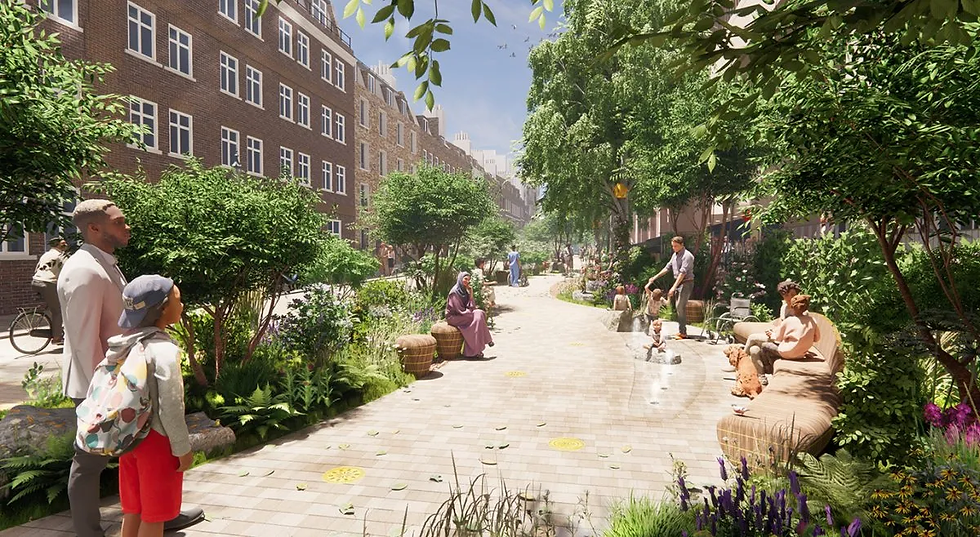
Image: London's healthiest hospital street, CGI courtesy of LDA Design
Sophie was asked about the importance of LDA Design's work to create better space outside the British Museum which is part of its 'Liveable Holborn Neighbourhood' project. She commented:
'We have a cultural engagement perspective, we have a good relationship with the British Museum, and I think all the conversations that we've had with them around our master plan is around how we connect the community back into that space. I think it's incredibly difficult for them because they are serving three audiences, international, national and local, and our conversation with them is around how are we ensuring that local people feel that the museum is as much their own as it is for international audiences.
'Just for the benefit of everyone here, the whole Holborn Liveable Neighbourhood project is a partnership project that Camden is leading in partnership with Transport for London, and it is a very radical project which effectively is hundreds of hectares right across from Great Ormond Street Hospital to the area around the British Museum, south Kingsway, High Holborn, New Oxford Street, and it removes the one-way system around there.
'So a lot of it is around reclaiming space. It's removing the one-way system, and by virtue of doing that, you're then able to re-assign space and close certain streets. So one of the streets that's been closed to traffic is Great Russell Street, and this is a project that has been sort of planned from a public realm strategy from back to May ten years ago, right to now, to secure the funding and trying to work with partners. The key thing here is about actually taking the museum and beyond the walls into the public realm and creating that as kind of a place where you take the essence of the history of the city.

Sophie continued:
'We are also thinking about climate resilience activation, to start the dialogue between inside and outside, and that's a big focus for the whole project. A lot is happening, all sorts of buildings around London, not just the British Museum, We've got lots of cultural institutions that are much smaller, so how do you bring them out? And that might be around performance. So simply put, it's creating space and power and water so actually future events can happen. Heat resilience is a key thing. We have a heat resilience study done by Shade UK and, you know, actually the forecourt of the British Museum is one of the most intensive places in the area. So actually how can that start to create a more comfortable place for waiting and it is a serious health issue now.
'It is around working with the community, because obviously there's lots of narratives around things like 15 minute cities that are quite unhelpful to this conversation, it's as simple as that. It's about just living somewhere where you can shop, you can work, you can live in enjoyment. I think Camden, going back to Holborn, we are working really hard on actually trying to engage the community, because again, in places like Holborn, there is still a residential community there, and actually there are primary schools there, but unfortunately the numbers are decreasing, so how do we work to try and, you know, increase that? So I think it's around collaboration and also thinking and remembering that your own lived experience is not the same as most people in the borough. So like I said, we're going to be closing the streets and somebody who has got a van that they need to go to work or they're getting up at 5 or 6 in the morning to do something or the taxi driver, their issues are very different to my issues, how do you try and resolve those? So that lived experience I think is really important.'
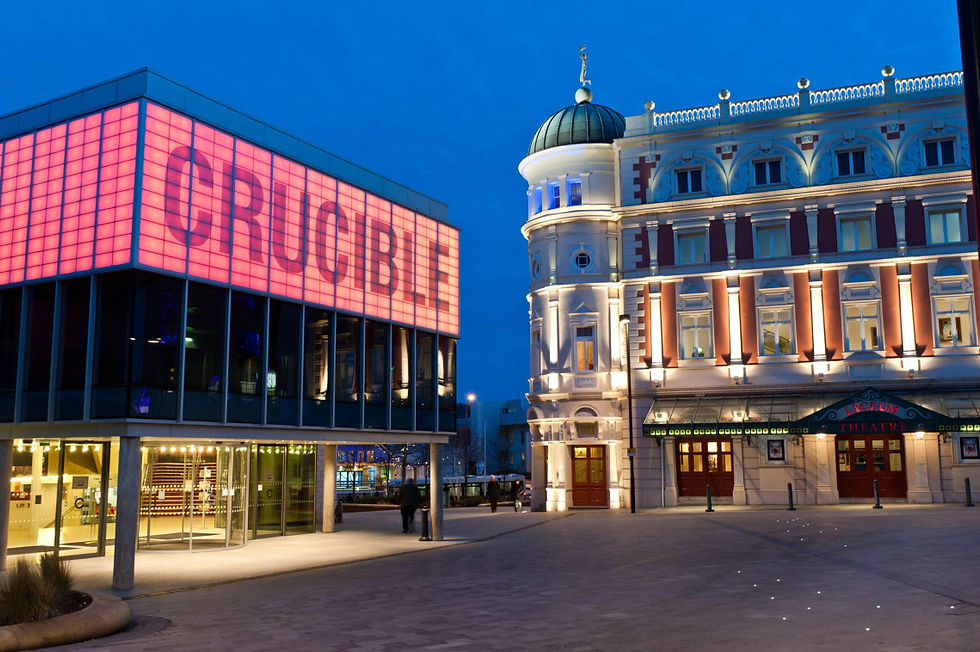
Image: view of the Crucible and Lyceum theatres - courtesy of Sheffield Theatres
How cities outside London continue to thrive culturally was an important discussion point at the event and Tom Bird, CEO, Sheffield Theatres, joined the panel to discuss the investment into the Crucible Theatre and how this might help Sheffield bid for the UK City of Culture 2029.
Plans for a £45m investment in the redevelopment of Sheffield Theatres’ iconic Crucible Theatre are being developed, supporting its future as the UK’s largest producing theatre complex and underpinning the agreement for the World Snooker Championship to remain in Sheffield.
The proposed transformation of the Grade II listed venue is a once in a generation opportunity to invest in an extraordinary building of global and national significance.
The proposals link the Crucible’s future to wider regeneration plans and invite organisations to play a role in the next era of sport and culture in Sheffield. Separate arrangements have been agreed regarding the long-term future of the World Snooker Championship in the city.
Tom said:
'The theatre was built by an amazing actor called Tyrone Guthrie. But we came to understand that the world's famous snooker championships should stay in Sheffield. Bear in mind that Sheffield does not have loads and loads of cultural venues like London or Manchester, but it's still the fourth biggest city in England, nevertheless it doesn't have that much, in terms of international festivals, international recognition beyond the World Snooker Championships.
'There's a massive economic impact from the Snooker Championships. There's also something non-economic that's about pride and in the city that made it just crucial that we were able to keep it. And we're delighted that it's staying till 2045, possibly till 2050. In order to do that, we're redeveloping this theatre.
'It's loved by people, deeply loved by people, and it's 1971, not 1066, but it's still listed. In approaching that, we had to think, how do we retain the intimacy of this extraordinary theatre, what makes it brilliant for theatre and what makes it brilliant for snooker?
Tom was asked whether people really know that Sheffield has 25,000 creatives in the city and whether the city should promote its levels of creativity more? He replied:
'Sheffield is an extraordinarily modest place. It has just an extraordinary cultural heritage and is an extraordinary kind of gift to the world. And some of the funding that we receive compared to overseas, for example, the Arts Council funding per head, I think we get six quid, Leeds gets 35 quid, Manchester gets over 50 quid, and London, even with its massive population, is, I think, well below 100 quid. And I think part of the reason for that inequality of funding, which must be addressed, is maybe not sharing enough funds. So it is important to make sure that we, as a city, and other cities like this, unashamedly kind of shout about the extraordinary kind of gifts that we've given to the culture of the UK.'
He was then asked about being on the long list for the UK City of Culture 2029:
' Sheffield is a city of culture already, but as a place I think we're still looking for ways to emerge from an extraordinary steel making heritage. It's a city of makers, every knife and fork on every table, you can turn it around and you can see these tiny letters, Sheffield. So we're a 'City of Makers' and that making has changed from making steel and making cutlery to making extraordinary culture and the City of Culture would just allow that to be recognised more and would allow us to accelerate that amazing progress.'

Milton Keynes is also on the long list for the UK City of Culture 2029 and Paul Thomas was asked about its unique approach to its bid, bringing technology innovation into its cultural offer:
'Milton Keynes as a city will be 60 next year. Most of the tables and chairs in this room are probably older than Milton Keynes is. But culture is not about history. It's not about time spent, I think it is about innovation, it's about growth, it's about opportunity. And that's the point we'll be making in our City of Culture submission. We're probably a couple of generations old, we're just getting started as a city. Yet we are still really successful.
'We are the fastest growing city in the UK. We are, according to The Times, one of the best places to live in the UK, which is a far cry from the classic, you know, you can't feed the cows and the roundabouts and other kind of disparaging thoughts and feelings from those people that don't know the city. So I'm not saying, nobody's got culture wrong, everybody has their own version of culture. Our version of culture has to be about newness and opportunity and growth. It can't be about history, it can't be about the classic amazing stuff that you can see out the window now.'
'History does inform, and a lot of the people that have moved into Milton Keynes as it's been growing bring their own history, bring their own culture, bring their own communities and they gather together. Bletchley Park and HMGCC (His Majesty's Government Communications Centre), which was intentionally very secretive and is now suffering from it because nobody knows where HMGCC is. If you count up, how many here know HMGCC? No, nobody. You've got GCHQ in Cheltenham. People are listening in on activity around the world, HMGCC make the tech for GCHQ. So they're the engineers behind all of our national security. 3,000 people working to the north of Milton Keynes. And they are a huge part of Milton Keynes and hugely important to the nation.
'We've got these little kind of treasures dotted around the city, and together they're kind of coming together to form the culture. But it isn't about history, it's (not) about Bletchley Park how invented the computer, that's now moved on so far from the original concept. National security has moved on, and we need to move on as a city.
'We're on the short list of new towns as well as the short list for City of Culture. And our pitch, if you like, to DCMS, to MHCLG, to HMT, to every civil government department is 'look at your kids, look at the way we're growing, back us, back us as a city, and then you can learn from us as you inform other new talents, because the whole nation needs to grow. The way you look at how it is growing at the moment and how that needs to kind of take the leaf out of our books.'
Paul was asked:
'Going back to the traditional sort of culture, bringing in Universal Studios Great Britain, when we were doing the forum over at the Milton Keynes council offices not so long ago the leader was getting terribly cross that he couldn't have a dedicated bus service to get from Milton Keynes directly out to Universal's planned theme park just to the south of Bedford.'
Paul responded:
'So the issue we've got is that Universal's Theme Park is being built south of Bedford, fifteen miles north east of MK, and it will be open in 2031, from 2031 onwards, it will have 8 million visitors, which is bigger than Disneyland Paris, and it's bigger (in visitor numbers) than the Tower of London. It's a different version of culture - it's roller coasters - and it's not everything you see outside today. The frustration that our leader had was that administrative boundaries are preventing what is quite an obvious route from Milton Keynes to the Universal theme park, where thousands of visitors each day will come into MK Central train station and need to get to the Park and we can't put the bus on because we don't have the franchising powers and those franchising powers wouldn't allow us to cross the boundary. So there's a bigger issue there with the way the UK government is so siloed that you can't do common sense things. So we will crack it, I will run a bus with Pete and he will be grateful for it.'

Geoff Field from Middlesbrough Council also followed Paul Thomas in highlighting the city's growing digital sector and how this is important to the City of Culture 2029 bid:
'So anyone who thinks of Middlesbrough will think of an old industrial town in the North East. But Middlesbrough is very much not that anymore and is in the kind of position where it's changing from its old industrial heritage. There's a lot of industry still in Teesside and the development of Tees Works, but we are the second fastest growing digital sector in the country. Around Middlesbrough there's around 170 firms who are developing computer games for the whole of the world. Any games which you have played on, or your family have played on, at some point will probably touch Middlesbrough and the industry that we have there.
'So our vision at Middlesbrough is to kind of look at our industrial past, both the place and the railways, the Sydney Harbour Bridge, all of those things that we've done, and look at that creativity, the creativity of the S&T side, and ask the question in terms of our new technologies that are coming through, which Middlesbrough is very much at the forefront of, how is that going to act with culture? What does it mean for the future of culture? And to ask something about some of the small things we talked about at the beginning, these new galleries that we've put in there. And so we're going to really ask the question about digital technology, how it affects our communities, what communities look like in the future, how does that link into the artistic community, will we have a position where we've seen digital ceramics being produced on 3D printers and things like that?
'What is the kind of new landscape and that's the question we're going to ask in our City of Culture. Yes we've got a history, we've got an amazing history, it's a fantastic place to be and Middlesbrough, you know fantastic people, a town full of modernists if you want to describe it as that, but the Turner Prize is coming to Middlesbrough this year which I hope you'll all come and see and our amazing MIMA Gallery which is absolutely punching above its weight in in terms of being a fantastic modern art institute right in the heart of Middlesbrough. It's such a creative place, and so we will see that if the City of Culture 2029 comes to Middlesbrough, it will really boost our creativity growth, and once again, it's a powerhouse in terms of future development, which we've always been describing as the 'Infant Hercules', and that's what we want to be again, but in kind of digital setting.'
'Middlesbrough's a really diverse place. It's a town that's been built on new arrivals coming in to Middlesbrough. We're 200 years old next year. We've gone from a town of 600 to the 'Infant Hercules' description (dating to a visit by Chancellor William Gladstone in 1862) to where we are now in a very, very short period of time. Built on new arrivals coming in, and Middlesbrough's a very, very diverse place and creative place because of that.'
'We've got a storytelling festival coming up over the summer and one of the parts of that is we've got story writers and artists in communities capturing those social histories and those stories of individuals and families who have come into the town very recently and those who have been there for many years traditionally. So yes, we're absolutely capturing that and we want - through this storytelling festival - to tell the new story of Middlesbrough which is dynamic and exciting.'

Image: Portsmouth (courtesy Unsplash)
Further south Councillor Steve Pitt, Leader of Portsmouth City Council joined the panel discussion to describe the city's ambitions to become a leading waterfront city internationally and how he thinks of best practice in attracting new investment for culture and tourism:
'So I think it's important to look back a bit to what happened to Portsmouth when shipbuilding left the dockyard because generations including my father and grandfather just automatically assumed you'd get a job in the dockyard And unfortunately when shipbuilding ended, the government response to it at the time was to appoint a Minister for Portsmouth, but in my view that hasn't been very successful.
'In the meantime the city has been evolving, changing, growing and reinventing itself anyway and we felt that we had a really strong and powerful artistic community that were being largely ignored by the big funding bodies and so we went out and directly challenged the funding bodies and said do you really understand Portsmouth? And I'm in a quite unique place as a council leader, I'm actually a member of the creative community as well, so I described to ACE at the time a local professional French theatre company that works on new work but also produces established work and workshops, and what would you say if I told you that company exists in Portsmouth and they've produced 50 productions over the 12 years or so and they've never had any Arts Council funding?
'I said, to the Arts Council, well that's my theatre company, so if you don't know about that, then we've got a relationship problem, don't we? And we moved forward very quickly from that point, and we've always had a strong relationship with the National Lottery Heritage Fund as well. But it's been about getting attention to that activity, and proving that what we actually have in Portsmouth can leverage real change.
'We've got a coastal community issue, we've got intergenerational poverty that goes back seven or eight generations, people have been surviving on low incomes forever. And there's a word that hasn't been used today that is, to me, pivotal in everything when you look at the role of culture in leveraging regeneration, and that's the word 'aspiration'. And what often happens, with every project that we've heard mentioned today, Doom.
'I go to a lot of these sorts of events, when people come in and do a project, and they will say, as part of their KPI's for that project, they're going to work with twenty families from disadvantaged backgrounds in areas that are just highly unprofitable in the seas of deprivation, blah, blah, blah, we all know how that works, and they will. And they'll do their evaluation at the end of the project, and then they'll feed it back. And they'll have done that, and everybody thinks, oh, that's great. And somebody else goes and puts in a Civil Rights Council bid, or National Lottery Heritage bid, and they'll also say the exact same thing, and they will, but it'll be the same twenty families. And that's the massive problem, and that's where I see City of Culture for us being able to leverage changeover. Because it's not, and we all keep saying this, it's not about doing to, it's about doing with.
'But what does that really mean, if you're only doing it with the same people, the people who are looking up, the people who are seeking to be inspired, and have aspirations for their young people, their children, their grandchildren, to do the things that they didn't do. It's got to be deeper into those communities, and the big impact that a city of culture opportunity can have is to do that really in-depth, where if I'm fascinated by artists moving into communities, it's something I've been advocating for for a very long time. Because that's how it works.
'You need to go in and get under the skin of what's going on, and really understand it. Because doing it with, when you were going to do it anyway, still doesn't work. And as we heard earlier on, doing it with when you've got the opportunity to really enable those communities to make those decisions is what puts that massive change in place. And then you get the investment, then you get all the other stuff that flows with it. But you've got to get those foundations right first.
Steve was also asked about Portsmouth 100, and a newly commissioned memorial to the late Queen Elizabeth:
' So, we're not defining it as a statue. We've suggested to the people of Portsmouth that they may want a statue. The Queen had a very strong relationship with the city, visited them a number of times for different reasons. The council will put some funding into it. I don't see it as one of the landmark projects that we're doing. It's something that the council feels that people should have the opportunity to invest in if they want to. And it sort of talks to that ethos that I've just mentioned, that we want them to tell us what they want. So we'll help make it happen, but we didn't want to just commission somebody to design a statue and stand there with their hands on their head. So it doesn't have to look magnificent. We want a memorial that's fitting, and it will be fitting if it's right for the city.'

Architect, Neil Michels, from Carmody Groarke, continued with the topic of heritage and the sustainability work that the firm is carrying out to make cultural buildings fit for the future and to meet climate change goals. He spoke first about the firm's project for the British Library campus in Boston Spa, Yorkshire:
'You probably all know the library in St. Pancras. You probably don't know that there are 500 staff working on a former military base in Yorkshire, and over 800 kilometres of books are stored there by the library. So we're working on a plan to decarbonise that site and provide better accommodation for the staff. As part of that, the first site officially opened in October is a single building which will house around six million collections. It will be 100% passive, so what that's doing is reducing the Library's energy bill to a third of what it is now, but it also provides new workplaces and new spaces to bring people in to see that collection and the activity.
'What we have been working on is quite a radical building. It's run by robots, so the books are taken on and off-shelf by robots, and then staff can work in very nice day-to-day space, and the public can come in and sort of see the scale of that. So this is about the public not necessarily engaging with collections in the traditional way, but understanding what the Library does at that scale. Why are there 500 staff? Why has the nation decided to store every book and every magazine that was ever published? And what does that look like at scale? So this is a very different story about an institution, not one about just picking up books and reading them, but understanding what they do to care for them.'
The practice states:
The 44-acre campus, formerly a Second World War munitions factory, is home to more than three-quarters of the British Library’s collection of over 170 million items. In the last ten years around 7 million physical items have been added to the library’s archives; requiring about 8km of new shelving annually. By the end of this decade the current storage facilities are projected to be full.
The masterplan is intended to create a more outward facing campus, to increase the capacity and quality of storage for the national collection, to create a better place for people to work, and to vastly improve the long-term environmental sustainability of the site.
The project encompasses two buildings: a new fully-automated, passive archive building that will allow for the expansion of the collection for decades to come, and a significant renovation and adaptation of the Brutalist Urquhart Building, the first purpose-built building for the British Library, which was constructed in the 1970s.
The building will be wrapped in a high-performance, air-tight envelope to protect the automation systems while passive climate control will lower the energy used in operation. The horizontal divisions of anodised aluminium panels reference the original Urquhart Building and reflect the images of the surrounding landscape, providing a distinct architectural character for the building.

Neil then talked about the important work that Carmody Groarke has been undertaking at the Science + Industry Museum in Manchester, the importance of preserving the buildings and collections for future generations:
'These buildings form the first passenger railway station in the world, and there are a number of early warehouses that were used to transport goods, primarily between Liverpool and Manchester. So they are buildings with good balance. They're big warehouses, primarily constructed of contemporary brick, which power for generations from the industrial revolution, coal. So what we spent a lot of time doing, when working with the museum, was looking at where they were wasting all their energy? Also, what infrastructure did they have? We found a huge old well on site that was used originally to bring water up to cool down some of those steam engines. That's a fantastic piece of ground source equipment now, where we're using the old infrastructure to tell new stories about decarbonising.
'The biggest carbon output of the Science Museum group was running old steam exhibits, so all of the MPP, all of the equipment is on show in this gallery in an old warehouse. So right from the start you can see a low-carbon approach to running those pieces. People can engage in that technology rather than hiding it away. Yet we still have these fantastic, great-quality buildings, looking majestic, albeit with new roofs and new glazing, but still having their fantastic character, just highlighting those stories.
The firm adds:
'Combining sensitive heritage preservation works with a future-facing decarbonisation scheme, the Grade II listed heritage restoration of Power Hall: The Andrew Law Gallery at the Science and Industry Museum breathes new life into one of the most important surviving buildings of the industrial revolution.
'New interventions within the Power Hall are transformative yet discreet, so that the heritage of architecture and collections are foregrounded. Entirely new visitor circulation improves accessibility and legibility; improvements to the existing building fabric optimise energy efficiency; and new interventions into the historic facades open up new views between the city outside and the collection inside.'

Battersea Power Station - cafe and landscaping, courtesy of LDA Design
Turning to the re-development of another historic building - Battersea Power Station, Sarah Banham, Head of Communities and Sustainability, spoke about how the site resonates through past generations but is looking to the future to involve communities in vibrant expressions of creativity:
'So I think the vision for the power station was always that it had to be first for the community, because even though they'd never been in it, and it was just a desolate site, they felt they owned it. It belonged to them. It was a symbol of Battersea, and before it closed down 30 years earlier, their parents and their grandparents had all worked in it and dominated their lives, and it dominated the lives of North Battersea.
'So it was really important from that first master plan that we engaged with them, and then that's evolved over time, and we now have our four Cs, or our four chimneys, but it's culture, community, commerce, and curiosity. And curiosity is that sense of discovery, and finding different elements, not just of the building, but of the new buildings of the site, and finding different things that address themselves to different audiences. So we have got many, many different interventions, some incredibly small. We have an artist in residence, Michael Warren, who's been drawing the power station for 42 years now, so when it was a completely empty site, and he's now got his pictures hanging on one of the turbine boards.
'As part of London Borough of Culture, he did a full-day sketching, with just the general public coming forward and seeing him. We created a community choir, because that was to break down those perceived red-line boundaries, and that's people across Wandsworth just come and sing. It's got no agenda whatsoever, but they've sung in Trafalgar Square for Jamie Cullum, they've sung in Sting, they're just ordinary people from our local community. And then we do the sort of more big set stage things, so we have an annual festival called CelebrASIA, and that celebrates the culture of Southeast Asian nations, so they all come. And we've got lots of food trucks, and lots of dancing, lots of different craft works. So it's just a whole creative programme, but reaching out, I think, with community and culture at the heart of it.'
Sarah was asked about the specially created high street, Electric Boulevard, on site and how it could be made to fit in amongst the heritage?
'So Electric Boulevard is linking the southern face of the power station with Battersea Park Road, and then all the estates in the hinterland of that. So it's really important that you get that three-way, but also that sense of discovery, so it wriggles, it's not just a sort of straight-through view of the power station. It was always meant to be one of those routes of discovery, but we've been utterly amazed at how successful it's been in its own right. People just dwell there. It catches a lot of sun. It's planted very well, it's on different levels. The mix of retail has really appealed, and since another tube entrance has opened, we're now slightly concerned that people will spend too long in Electric Boulevard and not actually come into the power station itself, which is sort of hoisted by our own success on that one, I suppose.'
An additional question was put to Sarah about other measures concerning sustainability, namely the new energy plant being built next door, Cringle Dock waste transfer station. She said:
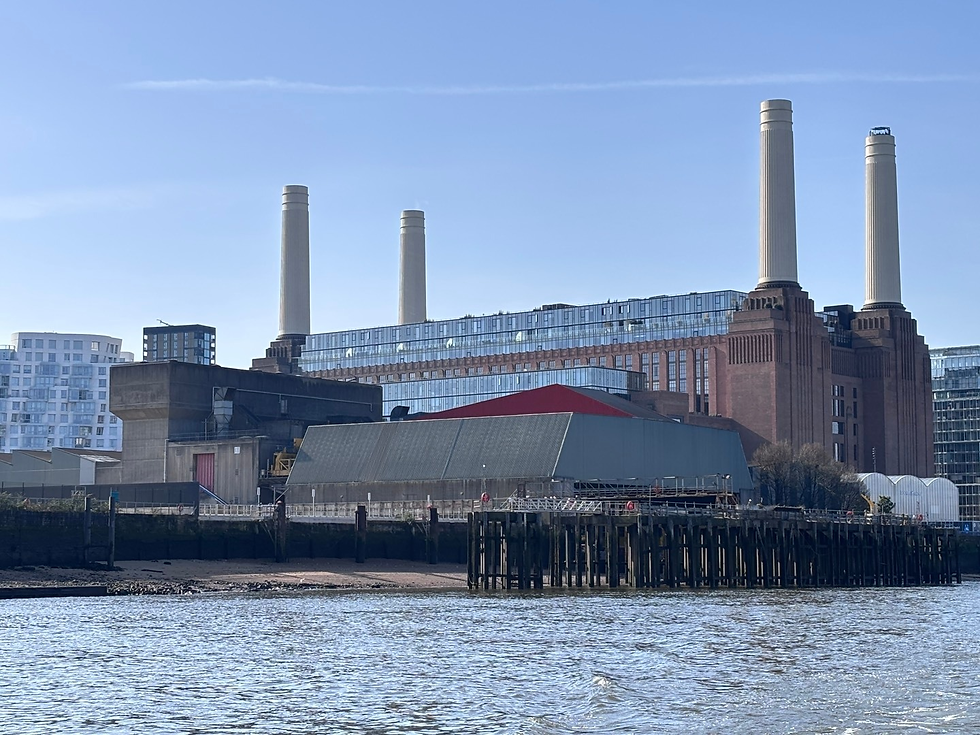
'That is owned by Western Riverside Waste Authority, and they are looking at bringing forward their own scheme for that. But of course we have to chat to them, because we share that sort of ongoing part of riverbank. But then we also were an energy plant ourselves. We powered a fifth of London. We were a major generator for London. And so I think what we are now looking at is, as part of that future phase, the next 3.5 million square feet that we're bringing forward, what will be that next big thing for London? What will power and help this area? And it's not just that, you see, it's thinking big. It's thinking London and thinking nationally. How do we compete globally?'
Image: Battersea Power Station with Cringle Dock waste transfer station in foreground - courtesy of Grimshaw
Comments