


Future Cities Forum's interview with Grimshaw on designing vertical university campuses
Updated: Apr 26

Image: courtesy of Grimshaw
Future Cities Forum has been talking to Grimshaw partner, Keith Brewis, about the design and development of Monash University Malaysia, as part of our discussion event series 'Student Cities'.
The University has announced its partnership with TRX City Sdn Bhd, the master developer of Tun Razak Exchange, to establish a campus for the university in the heart of Kuala Lumpur. The new campus, designed by Grimshaw and GDP, will be one of the university’s largest international education commitments and forms a key part of Malaysia’s International Financial Centre.
Grimshaw states:
'Located in the TRX Urban Quarter, the vertical campus concept for the 1.5million ft² development is shaped by its dense city context and the university’s ambition to create a world class sustainable, interactive eco-system for education. Ultimately accommodating 22,000 students when it opens in 2032, the design works in direct relationship with the evolved pedagogy of the university where learning is active and collaborative, enabling exchange between departments and disciplines and the advancement of knowledge.'
Keith described to Future Cities Forum how the project has developed:
'For about 25 years, the University has had a full university campus, which has been operating successfully within Kuala Lumpur and within Malaysia. But the campus itself has taken the form of a traditional 'edge of city', which is made up of buildings that provide three levels of occupation for the university, and then slightly higher buildings for student accommodation.
'Students are 'parked' out of that and they're outside of the city with a passive relationship to the city economy. Monash has operated there for 25 years and then their lease on that land was up and they were considering reinvesting in that space. Then there was an opportunity right in the middle of of Kuala Lumpur, where we had been fortuitous to do part of the major master planning in relationship to what's called a lifestyle quarter, whereby there was a second central business district that had been developed by TRX, Tung Razak Exchange, who were part of a sovereign wealth fund that sits within Malaysia.
'The buildings were very high-rise, but circling a central piece that we had master-planned that was predominantly retail, F&B, public realm, but there was also a major parkland on top of its roof. So you've got all these high-rise buildings plugging into a rooftop parkland with a lot of retail and stuff sitting underneath it, and that's formed a new financial and services centre and a place of living for people within Kuala Lumpur right in the city centre.
'Monash suddenly has seen a massive surge in the demands for student attendance at its university in Kuala Lumpur, because it serves as a regional centre for an Australian university in Asia, rather than Asian students going to Australia.
'On the back of that, it saw the need for very substantial growth. And then there was a call for an expression of interest from a series of land owners and land developers to provide a long-term university for Monash, and they would guarantee a 30-year lease over that term. So it could be very attractive as long as you could finance the debt and finance the capital, the initial capital expenditure. We had formed a relationship with TRX, who held the land, and were able also to borrow at highly competitive government rates in terms of construction and capital outlay. And they asked us to do a speculative design on a piece of land just south of where this lifestyle quarter the financial centre was - and we thought about a high-rise interlocking total university campus and that's where we've ended up.
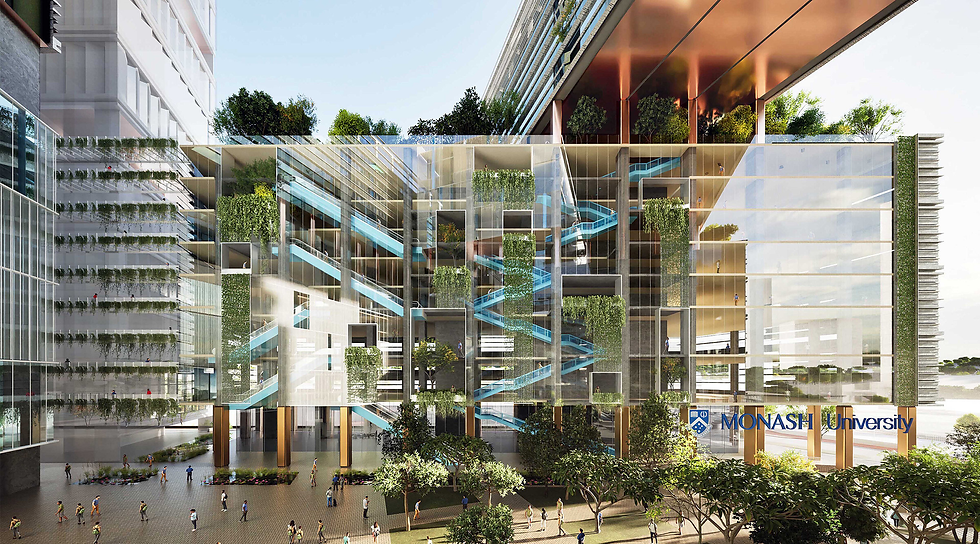
'We've formed effectively a vertical part of the campus. And then we've interlocked some very large departments that span around the perimeter of that central open atria area. So you've got this very, very substantial courtyard. All of the movement patterns between departments are up the side of the concourse, very much like an inverted Pompidou centre where you can work your way up through the building and be very much on show around this central courtyard. And then the blocks themselves have a language and an identity which speaks about what is in them and what are they doing and who do they collaborate with.'

Image: courtesy of Grimshaw
Keith continued:
'So the whole lot becomes like a Rubik's Cube of interlocking building blocks that tie into each other and have a relationship around the social heart and obviously then protect and have a relationship to the broader city. Now the key thing is that TRX, who are the long-term custodians and owners of the lifestyle quarter in this new financial district, with its retail, with its food and beverage, with its community, with a lot of commercial office space, with a couple of hotels, with a lot of new tall residential apartment buildings, are seeing a massive upside synergy in terms of plugging a university, a big university culture, and the kind of the invention, the innovation, the youth, the vibrancy that comes with a university into what would otherwise be a separated business centre within the city. So you're getting the university society feeding into the commercial and commodity economies that would normally exist in city centres.'
'So it's that kind of the fusion of academia, but also of discovery. You are then plugging discovery into industry, and then wrapping an economy around that, and then you get a kind of a supercharged urban economy, because you've interconnected these things at that scale.
'Obviously there are some students will want to go to a campus style university and they think they want the sort of lush surrounds that they might get and it is massive and I don't know how many acres, but it's a rooftop green park .At the same time in many ways, what we've done is we've taken the traditional sort of quadrangle university model with the kind of cloisters around it. I thought we'll pick that up and then we'll take one of the sides off it and stack another one on top of it and rotate and stack another one on top of it and rotate it and stack another one on it and rotate it etc. And so you end up with opportunities for great public institutions throughout that structure, with the opportunity for great amenity space, great places for intimate retreat, and then socially vibrant places.
'It's more intense than the traditional colleges like those in Oxford and Cambridge, but nonetheless, it has the same variety.'
Image: courtesy of Grimshaw Global
Keith described the importance of managing the green aspect to the University:
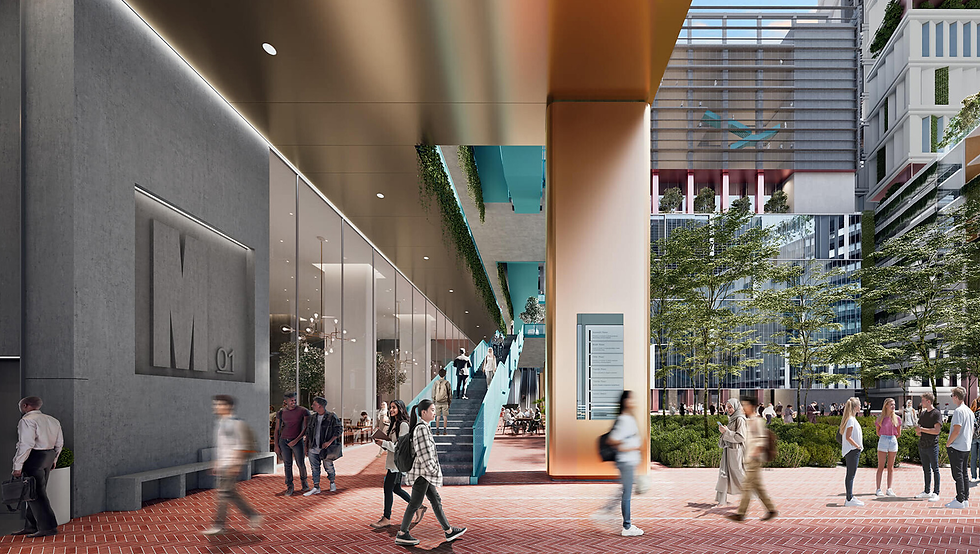
'This kind of jungle re-occupies because you've got massive sunlight, massive humidity, massive rainfall, fertile soil. I've been saying to my team is, if you're talking, if you're drawing, if you're photoshopping or modelling and putting a tree onto a plan, you've got to understand what you mean by the tree, what is its ultimate scale? How do you manage it? What is it going to need to thrive? How big will it be in ten, twenty or thirty years. And if we're not intending for it to be that, let's take it out. You have to be very disciplined in terms of where to put proper tree planting and where otherwise to put planting, which helps with the moderation of daylight, the moderation of temperature, the kind of creepers and stuff like that, which really thrive.
'But again, to an extent, they need to be maintained, because they will take over. And they need the nutrients. They'll get the water and they'll get the sunlight, but there's got to be some nutrient feed to them. So I think we're just at that point at the moment where we're moving from the end of concept into more detailed development. And with each tree , you're thinking about it being a really precious thing that you know in thirty years will be symbolic in many ways. You might think about some of the great oak trees within Oxford or Cambridge, the kind of willows against the canal edges and they're really symbolic, they're great places of congregation or association.'
Image: courtesy of Grimshaw Global
Comments