


New towns, innovation clusters and the Growth Corridor - report part two
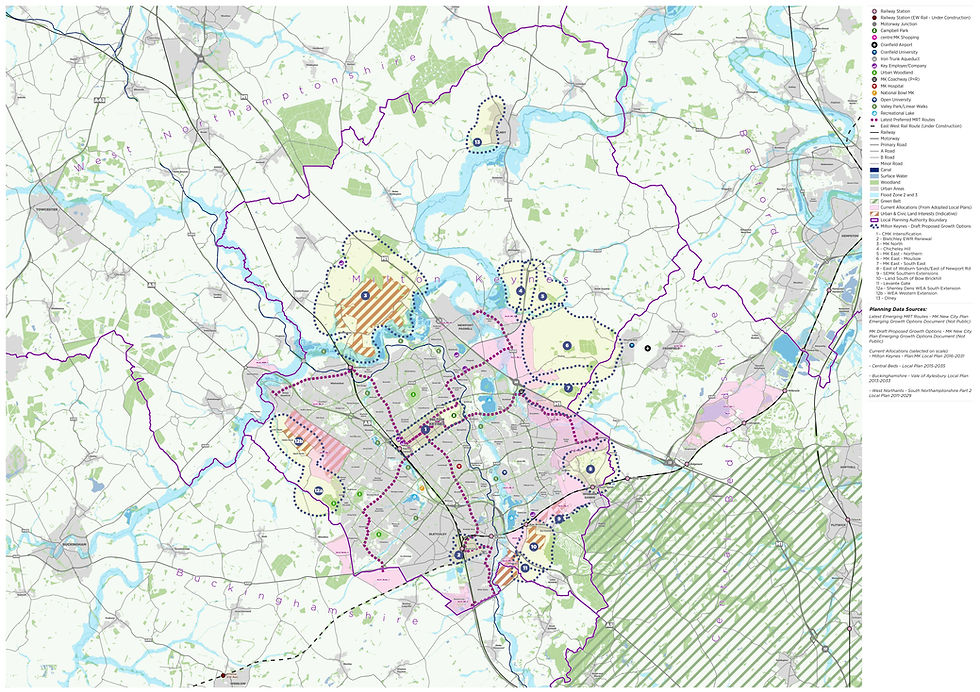
Image: Milton Keynes growth - allocations plan (courtesy David Lock Associates):
Future Cities Forum is releasing the second part of its report from our Milton Keynes City Council hosted discussion event 'New towns, innovation clusters and the Growth Corridor, with contributions from the Council, LDA Design, Urban&Civic, David Lock Associates and East West Rail.
Today, the locations of seven new towns have been named for consideration as part of its housebuilding programme by the UK government. Among them is Tempsford, Bedfordshire — where up to 40,000 homes are planned to be built around a new East West Rail station, linking residents to Cambridge, Oxford, London and Milton Keynes,
Others include Crews Hill and Chase Park, Enfield, Leeds South Bank, West Yorkshire, Manchester Victoria North, Greater Manchester, Thamesmead, Greenwich, Brabazon and the West Innovation Arc, South Gloucestershire.
The UK government says:
'Built for the future from the ground up, the next generation of new towns will create well-connected new communities with homes, jobs, schools, green space and transport links planned from the start. Each proposed location is expected to deliver at least 10,000 homes, with several delivering 40,000 or more in the decades to come.
'Milton Keynes, Buckinghamshire. building on its history as one of the original new towns, is to take forward the ‘renewed town’ vision to expand the city by around 40,000 homes and reinvigorate the centre with a new local transport system, boosting connectivity in the Oxford-Cambridge Growth Corridor.
'Furthermore, as part of the government’s drive to instil pride in our communities, these towns will be designed for modern, everyday life – with neighbourhoods that people can easily get around without a car, shared green spaces and vibrant high streets. Alongside the new towns consultation, the government has also confirmed today that the National Housing Bank will launch on 1 April. It will be backed with up to £16bn of financial capacity and will aim to deliver over 500,000 new homes.'
At our Future Cities Forum discussion event last week, at Milton Keynes City Council, the Director of Planning and Place, Paul Thomas, commented on the type of growth that is required:
'Growth as a whole needs to respect its history but not be constrained by it, so the works that we're looking at doing in the city centre, will maintain the grid but we won't maintain three storey buildings sparsely spread out across the city centre, we'll go taller, we'll go denser, we will reduce the loss of car parking, we will give over some of the road space to to enable mass rapid transit and our autonomous shuttle. So we are moving forward within the grid that was designed for the city. So people will still recognize, if you look at Milton Keynes in plan form, which is very similar to the same grid system, and that grid system will be maintained, but the development within it will look very different.
Paul was asked how the Council would be maintaining its net zero goals within that plan?
'Net zero is becoming more and more challenging. I don't think anybody really anticipated the economic challenges that we've had over the past few years, which have made construction, normal construction, prohibitive, yet alone construction that builds in all of the environmental features that we would want to see. So it's more challenging, but the aspirations of the city are still there. The mass transit system is a big step towards achieving greater carbon neutrality and we're leading that. We're leading that despite what government says, not because of what government has said. In conversations with MHCLG and DfT, we're seeing the contrast between a vision-led approach versus, well, what's wrong with your roads? So we're doing what we can locally but as the Leader said earlier we're doing that despite what government is trying to do to us.'
Paul then spoke about Oxford's planned development corporation, and whether Milton Keynes should have the same. He said:
'I think the proposed development corporation is evidence of support. Our track record of delivery over the past few years has been substantial, both in terms of housing growth and economic growth, and probably a number of other factors as well. A development corporation will take two, three years to set up and we can't wait for that. What we've said to government is with the best will in the world - and Nigel's sitting here with Tempsford as well as MK North - the other new town proposals won't deliver houses within the term of this parliament and maybe where you've got fields within the next five or ten years.
'Milton Keynes will deliver homes in new towns next year. So we're doing that even though we don't have a development corporation. I'm not saying we'll never need a development corporation because when you've got potentially investment from government of two, three hundred million pounds it's going to want to make sure that it's looked after and that it's actually assisting delivery and will probably want to step in if it's not.
'Likewise if we've got developers who have land around the city and they're not delivering as we would expect them to do, we would expect to be able to step in and sort that out as well and if we've got landowners who have got too higher land value aspirations and that's competing with our ability to deliver affordable housing, we would want to step in there and make sure we're getting full land value capture. So at the moment we're delivering pretty well, but at some point in the future where we still want to be aspiring to deliver growth we might need some assistance and and some different governing structure to make that happen.

David Bell, Director, LDA Design joined the conversation to talk about the delivery of homes and infrastructure in Oxford and the sometimes complicated political situation in the city:
'There are some challenges around delivery and there's a very palpable lack of strategic planning. The growth deal money that you referred to earlier Peter was tied up with the idea that there'd be a Oxfordshire 2050 plan but there's a big void in coordination. Then if you look at the Oxford Growth Commission's recommendations, four of the ten opportunity areas are all about growing around the edges of Oxford, but then you come into the challenge of governance because the edges of Oxford are controlled by different authorities. So that situation needs planning and Oxford itself doesn't control much of its greenbelt.
'So that trying to identify growth around the edge of the city and release of that area is reliant on that cooperation between authorities, and it's falling apart. That Centre for Cities piece that you referred to, the conclusion of that piece is that Cambridge has had the ability to deliver the homes, which comes with the technology and knowledge-based jobs. If you look at the allocations around South Oxford and the Cowley branch line area, they're bringing forward the jobs, but the homes are well behind in terms of what they can deliver. So the piece of the Cowley branch line that should be able to deliver is that combination of jobs and homes. But the issue is there's a lack of strategic planning.'
The subject of an anti-growth lobby in Oxfordshire then came up in the discussion and David commented:
'I think in Oxford City it's not so bad as some of the surrounding authorities. West Oxfordshire is planning for the number of homes that the standard method identifies, but the other authorities are sort of materially less than that. Releasing Greenbelt is a real challenge for those authorities, and when you come to sort of that discussion about where Oxford is, how that end of the arc grows, it's about developing homes around the science clusters. The recommendations are for agglomeration around Oxford, so that is a real challenge you need to overcome. So something like a development corporation might be a good idea for unlocking that.
'So the piece of work that we're commissioned at LDA Design to do at the moment, which is looking at a spatial plan to co-ordinate the three authorities that the County Branch Line covers. The make-up of that client group is quite interesting because it includes the city and the county, but not South of the Thames and not the Vale of the Whitehorse, because they didn't want to be part of the client group. They're going into a process where they're presenting their local plans, and we've been tasked by the Growth Commission to look at sites beyond allocations. South Oxfordshire is saying, we don't want to see any allocations outside of our plan process. They are participating, and we're doing workshops and it is constructive, but it's very difficult for the officer engagement and then the councillor engagement to get over that next phase of planning.'

How are other settlements developing within the Growth Corridor? David Lock Associates (DLA) has submitted an outline planning application to North Herts Council on behalf of Urban&Civic and Hertfordshire County Council for the “Growing Baldock” development comprising of up to 3,200 homes; employment land; community facilities, shops and services; primary and secondary school provision; new parkland, green spaces and play areas; and public transport, cycle and walking infrastructure.
DLA says the preparation and submission of the application follows two years of extensive consultation with stakeholders and the community and is the culmination of significant joint efforts to deliver much needed, sustainable growth for North Hertfordshire and Baldock. The submission marks the latest milestone for the project, following the earlier approval of the Growing Baldock Strategic Masterplan by North Herts Council in June this year.
DLA will now begin the important work of negotiating planning permission for the development, to ensure that it enables the timely delivery of homes and community facilities on this key North Herts strategic allocation.
Julia Foster, Managing Partner, at DLA, was asked to say whether the development will be simply sprawl or beautifully designed?
' It's a really interesting project from the point of view of thinking about growth on the edge of an existing settlement because the original conception for that extension actually treated it as quite a separate neighbourhood, which was seeking to create a whole new centre, whole new services and facilities to support its needs. And actually when Urban&Civic came in and picked up that site, it went completely back to the drawing board, and the nature of balance it uses, obviously significantly in residential. We're looking at a number of things. I'm not going to say it's not without controversy because it's of some scale. I think it's actually been well received and we have a very strong community, a positive community around it.'
Nigel Hugill, CEO of Urban&Civic commented:
'One of the things it introduces is the building of a new secondary school or to expand/improve the existing one. When planning these places, you have to think about people and life. You have to put in infrastructure like schools early on, so that's obviously very capital intensive. It's been a challenge because a market-driven model has obviously developed and is underpinned because of the amounts of money
'I think one of the things that people forget about in this world is the extent of use that Milton Keynes space has developed. And going back to Milton Keynes, it is conspicuously successful because of the fact that it's true that most people drive, but when they drive, they can barely often see a house. One of the things that the grid system does very effectively is it establishes neighbourhoods and so when you drive around your perception is very different.'

Image: courtesy East West Rail
As the UK government talks about the possible new settlement around Tempsford in the Growth Corridor, Will Gallagher, Chief Strategy & Development Officer, East West Rail, was asked about the ongoing issues of disruption from rail unions and the impact of the East West Rail train maintenance yard.
Headlines have appeared about driver only operations disrupting the schedule of the new landmark new rail line between Milton Keynes and Oxford until 2026 and separately about communities complaining around the siting of the EWR maintenance yard.
Will Gallagher said:
'Look, I think whenever you're developing a large infrastructure project, then there is going be disruption associated to that. And the best we can do, I think, is to be empathetic and understanding and actually have in place schemes that for those people who are going be adversely affected, that makes life a little bit better. But to pretend you can build a railway without disruption, frankly, is just intellectually dishonest. And we shouldn't do that.
'What all the data tells us is that there are some people who are very affected, very seriously affected, we will be demolishing homes and those sort of things. And you've got, as I say, people complaining about that. But there is a huge amount of support, actually, for the connectivity that East West Rail brings. The quicker we can get that connectivity happening, the better. So it is frustrating that we haven't got the services running between Oxford and Milton Keynes as we would like. I am hopeful we'll make some progress on that, and certainly I know the Secretary of State and the Rail Minister are very focused on how we get trains running as quickly as possible, because when I talk to both local residents and local businesses, they're very excited about getting that service up and running.
' I think the direction of travel on the railway, Great British Railways, nationalisation of the railways, there should theoretically be lots of alignment between where the government are going and the unions, and so hopefully there is a way to navigate through that, but just as, you know, local communities find change hard, you know, there is change happening in the railways and that isn't always easy either, but I think the direction of travel is clear and that's why on things like East West Rail, as I say, although there are areas of understandable concern, there is more commonly high levels of support and why is that?
'People do want to be able to see the opportunities of being able to travel into Milton Keynes, they do see the opportunities of being able to live in Bedford and work in Cambridge, or businesses see the opportunities to be able to locate where there is more affordable space but still top talent, Milton Keynes being a good example as well. So lots of reasons for that. That creates an obligation on us, I think, to make sure we design the right thing. I'm pleased that we are I think making progress on an eastern entrance at Bletchley station, great to see commitment towards the funding of that, so that we can get that into a good place, that will make a big difference to opportunity in Bletchley.'
Leader of Milton Keynes City Council, Peter Marland, commented:
'I think when we did our last conversation as well as the budget. I think that veered off into talking about how we plan capital expenditure and infrastructure in this country and I think it's a great example of how bonkers and just unhelpful this country is.
'Effectively we are waiting for a passing barge of central government money to come and say here's thirty million pounds for the eastern entrance and the same with the Cowley branch line. In most other places it would just be a given that Bletchley for the sake of thirty million pounds has an eastern entrance. I think how many houses are we currently promising - eight thousand you know in and around the centre, enabled by that transport development, and yet we're struggling to get thirty million pounds.
'ff we've just been able for instance to say for the next 30 years we're going to take half a percent of the extra business rates it generates because we've got such a centralised system with one organisation that's called the treasury with a grip on every single fiscal lever and it doesn't want to give it up, even if the returns of an individual place, taking individual decisions about what it wants to do, benefit the treasury, it very rarely comes back to benefit the individual place.
'I mean it's very difficult to say to someone in South Cambridgeshire or South Oxford or in lots of other places, you take all this growth, you have all this new industry you get the jobs but jobs will accrue there anyway it's the value added, but the money is going to be spent in Burnley or Accrington and Oldham.
'I don't begrudge that because those places have got a bad deal, what I do begrudge is another billion quid for another rail line in London to make London even more successful and the idea that we we have to scrabble around for 30 million quid, when it is essentially just. If it was a local decision that we could just tick it off, we would deliver it on our own risk with our own finances. It's a dangerous system to plan infrastructure in this country, and everybody has to dance to the Treasury's tune, and that is nonsense really.
'But I think this gets to, you know, it's not always easy, and does the system make it easier for most of us around this table to do our jobs? Not necessarily. However, even in the face of challenges, it is still possible to make progress, and I think what we are seeing on East West Rail and in other areas, actually, is we are making progress, not always because it's easy, but because there actually is, I think, an increasingly a line of view about the size of the opportunity between Oxford, Milton Keynes, Bedford and Cambridge.
'What you see is progress. We don't live in an isolated world where we're just one corridor. We're not fighting in the Oxford-Cambridge corridor, really, in inward investment, against Manchester, Greater Manchester or Liverpool City region or West Midlands. We're fighting against Shanghai, and New York, and Boston, and places in China and India. I went to China ten years ago now, and we landed in this airport. We looked out, it was some regional airport in the middle of nowhere, because they do the hopper flights. We looked out the window, and there was another airport. And I said, what's that? And they said, that's the former airport. And I said, oh, and what's that on the horizon? And they said, that's the high-speed rail. And I said, who's using it? And they said, well, we built it for the future. When I became leader in 2014, 12 years ago, East West Railway was meant to open in 2017. No, it's not. Progress is great, but progress is glacial.'
The third part of our report from the discussion at Milton Keynes City Council will be published shortly.
Image below: Milton Keynes City Council offices, where our event was held.

Comments