


Oxfordshire, science cities and the Growth Corridor - report part 2

Image: second panel discussion with seated from left - Anna Wai, Price & Myers, Dr Peter Leek, Oxford Quantum Circuits, Pete Wilder of Oxford science Enterprises, Artem Korolev, Mission Street, Eugene Sayers, Sheppard Robson (hidden),and Ed Hayden, Ridge and Partners.
Future Cities Forum's second panel at our January 'Science Cities' discussion event at Jesus College, Oxford, continued the debate around best practice in the development of sustainable lab spaces, attracting and retaining occupiers, the future for dark labs and the use of modern materials in construction of science buildings.
The discussion began with Pete Wilder, Head of Property and Operations at Oxford Science Enterprises, talking about the task of attracting high quality occupiers and what they are demanding in terms of space. Peter said:
' I started at Oxford Science Enterprises back in 2018, and if I look back now, I think actually the evolution of what's happened in Oxford is really quite remarkable. Sometimes it felt like we were wading through treacle, and that we would never quite get there, and now we've got millions of square feet that are coming through the pipeline. We've got some great companies evolving in Oxford, we have around 130 in our portfolio right now, and we're spinning out between 10 and 15 a year across our three sectors.
'Obviously the Ellison Institute has made a huge wave in Oxford over the last 12 months or so, and that's very exciting, just adds to the level of gravity and pull to others to come and join, it helps us bring in investors, entrepreneurs, academics as well. However, I think what we're seeing is that the range of space, the choice of space is still relatively limited.
'A lot of development was prompted by some big investment numbers back in 2019 and 2020. I think a lot of present companies excepted, but a lot of landlords thought that actually what we really need is really big floor plates to suit large companies looking at 50,000 to 100,000 feet.
'What's evolved actually is that the need is more broad, reflective of the science that is delivered within Oxford, which is really quite unique. Yes of course we have need for early stage life science and grow on space for life science, but also similar space for deep tech and health tech incubators and grow on space and so on.
'And so I think probably bringing in a point from earlier, adaptability of space is really quite crucial, but also acknowledging that companies do have very specific needs. City centre, ring road, out of town, production, clinical trials, all those things are going to have to work together to deliver the right solution.
'I think the way that companies and the property industry interact in Oxford is, or probably more generally is probably a little bit broken. Probably goes back to sort of historic traditional ways and I think, and I know that people in this room are working hard to try and fix that, but I think probably for landlords to really understand the needs of companies and help them facilitate their own growth, whilst almost putting property as a product rather than, you know, this whole thing that requires hundreds of thousands of pounds and a huge amount of time and resources. That's probably the thing that's missing to my mind.'
Pete was asked about the importance of choosing the right location for lab spaces:
'These companies are solving some of the world's biggest challenges, so they feel like they can be quite picky, rightly so. And a lot of it is driven, as we've talked about before, a lot of it is driven by the search for the best talent. I think Artem can talk about the journey of Nucleome Therapeutics, for example, that was looking at a site way out of town versus the Inventa building on the Botley Road. And I think they overcame a £500,000 a year cost differential to move to the higher profile building because that's what they felt they needed for the development of their company, be it attracting talent, but also being in the right place for investors, as well as obviously working with a wonderful partner in Mission Street.'

Pete was asked to explain further the advantages of developing inner city labs:
'So I probably ought to explain a little bit about our involvement in real estate, because it's not normal for a venture builder to be involved in property, per se. But when OSE started, I think OSE at the time raised £600 million in capital, and the vision was really to establish for the first time the connections between academics, investors and entrepreneurs, and often for the first time bring those people into Oxford, especially the entrepreneurs and investors who perhaps haven't been looking at Oxford.
'But the problem that no-one identified at the time was Oxford has its own unique set-up, which meant that it didn't have the availability of the right sorts of buildings and so on. And obviously you then have an ownership base that might be sort of college or university-led who have different expectations in terms of return on investment and investment structures. So initially our first companies were operating out of converted flats in the station square, using kitchens as lab benches.
'And I think Nucleome was one of those. Vaccitech, which went on to invent the Oxford vaccine, was also one at the time. And so we realised in that very early stage that if we wanted to influence the outcome, we had to get involved in property ourselves. And that resulted in us providing some co-working space in our HQ at the time in King Charles House, and then leasing buildings in the science park. There was effectively plug-and-play labs provision for early-stage companies where they didn't have to borrow the rent deposit. They could sign up to a one-year rolling break and they could just move in and get going. Now the industry as a whole has caught up with us, and actually we were able to dispose of that space throughout last year, which was good for us because it means we can focus on our core business.
'But we did recognise that we have a role to play in the ecosystem. And we can help, and I think we've always done this. We can help support our wider partners in the ecosystem to make sure that they're aware of the companies that are coming through, and the sorts of science they're involved in, and how they might scale over time. And that was the reason why we started our partnership with the Pioneer Group and the Crown Estate. So we are a partner with Pioneer Group and the Crown Estate, and Debenhams is the first building that we have acquired together.
'And really leaning into some of the things we've talked about, we know that there is town centre demand for companies that want to be high profile, attract the best talent, they want to have access to the university campus and the academics, but they also want access to the food and beverage and all the good things that the city centre brings with it. And it's been a huge challenge to try and get it to work as a wet lab, but actually wet labs is where we see there's a really critical need for very, very small space, with benches up to 10-15 people. So that's what we're aiming for.
'So you've got delivery access, goods lifts, you've got on floor storage, you've got plant rooms, you've got sort of reasonable slab to slab heights. So you've got all these sort of natural features that mean you don't have to completely reinvent the wheel when going through the build. Yes, of course you can repurpose buildings, but in repurposing buildings you do have to make compromises in terms of what you're going to build out. And that's probably the big thing, to make sure that you can accommodate what you need within the fabric of the building.
'I think there's a role for all locations, but I think certainly we have picked up that for some early stage companies the ability to walk from the station is a really critical point, especially in those very early days when you might be bringing people in on the train for an hour or two. And the last thing they want to do once they arrive is get on the bus for another half hour, 45 minutes to a science park. But that is definitely part of the evolution as a company slows to then be able to move into larger, more bespoke space around the science parks and then into production at other locations. I see that very much as part of the journey.'

Dr Peter Leek, Chief Scientific Officer (and founder) at Oxford Quantum Circuits joined the panel discussion to compare how Oxford and Reading appeared as locations when he was starting and growing his business:
'So I maybe have to say some negative things just because of the history and context that I'm here under. Oxford Quantum Circuits is a spin out from the physics department. In the early days we were operating in some of the places Pete's just talked about, King Charles House, Cross Roots, so those were great. I think right now, if we went back in time, the next step has really required lab space for some of the things you just talked about, technical space, plant space, decent ceiling height, that kind of thing.
'Space potentially to grow as well, of course. I think we would be more likely to stay in Oxford by the sounds of things. I think maybe the very kind of straightforward and obvious thing was that with a start up spin out, you're trying to move at pace and there comes a point in time when you've got to find space. There's lots of factors, but you've got to find space that is actually available. You can weigh up all the other options, but there needs to be something available to you in the time scale that you need to get scaling up. There just wasn't anything available for us at the time.
'All kinds of excellent reasons why being in Oxford would be good. I think the kind of straightforward thing to say is the value in getting spin outs to establish themselves somewhere at the beginning, or maybe at this kind of early scale up stage where you're starting to grow a population of employees up to tens of employees, beyond that point, you start to get to this point where the employees are living in a certain area. That has to be a factor in your choices for the next steps. Now we're established in the Reading area. We have 150 employees.
'It's kind of impossible for us to move back to Oxford, even if the best place were here. We can't do it because the employee base is around there. We use technical facilities currently in Royal Holloway University in London, which is in southwest London and also in Southampton. The connectivity there is also decent. It's fine in Oxford too. That definitely wouldn't have been a factor were a comparable space available.
'I think if you're working in a space where there's a lot of competition for the talent, you do need to make sure you're providing the best environment to attract the talent to your company. We're at a point in time now where we're looking for the next steps. We're currently based in two places in Reading. One of which is the place we first moved to from Oxford, which is Thames Valley Science Park, which is a Reading University space. That has very poor transport links. We're in a second location which is actually based out of a data centre, which is another story. The space of data centres turns out to be extremely well technically suited to what we do. That has a station nearby. It's kind of a no-brainer that if we can find it, we'd go to the space near the station. There's a huge factor in that. There's an ability for people to get to and from work.
Peter was asked whether the UK government is doing enough to keep companies like Oxford Quantum Circuits in the UK? Peter replied:
'That's a good question. There have been some stories this year. I think at the moment, I would say yes. I think we have a very encouraging dialogue with government about that. There's a number of aspects to this. I think the investment side of things is one of the biggest angles here. Whether in the UK you can attract investment at the scale-up stage that we're at, versus moving to America and getting into a very different investment landscape. I think they've moved in the right direction in the last couple of years on that.
'There have been some announcements in recent months about investment in quantum tech going forward into the next few years. I think there might be some more coming this year. We hear encouraging noises that they're likely to keep up that investment in quantum tech. Fingers crossed, I would say. I think the signs are good.'
The panel widened to the challenges and opportunities in setting up an innovation district and what the future is going to mean for Oxford. Mission Street's Artem Korolev responded:
'I guess I'll sort of use as a case study what we're doing in Oxford, because obviously we're active in other cities as well. Oxford's probably the furthest advanced of where we are. When I set up the company in 2017, our focus has very much been how do we build parts of cities with science, innovation, and not just life sciences, but that combination of different types of research, which I'll get to in a second in terms of our lessons learned on that.
'How do we actually do that? Because there is another trend, and back in 2017 when I started, that was not a UK trend. The starting point for us in Oxford is we started thinking about where would one realise that vision? Where has that vision been built historically for all sorts of reasons, planning, land ownership, etc.? Where would you do that? When we zoomed out, what struck us was Oxford doesn't really have a proper CBD from a commercial standpoint, nor a sort of urban science location at scale. If you look at the way that the city is built up, it's got all of this historic park with beautiful buildings. It's got elements which for various reasons at some point probably will be developed with our longer-term project. If you look at the transformation, there are positive and negative positions on it.
'I think it's very much net positive, CB1 in Cambridge. If we take a UK example, the ability to build near the city centre critical mass has been very positive to pulling bigger companies, tech companies, scaling companies in the Cambridge context. We started looking at how can we actually create that here? For us, we got really, really excited when we started looking at that entire west end strip of the city coming out from the railway station and heading out west broadly on the Botley Road and through the Botley Road Retail Park.
'It's not the most beautiful part of the world, but it's 10, 15 minutes all of it from the railway station at scale. I do think even in government discussion on this, the scale of the opportunity in the west end is what I think is probably the biggest urban innovation opportunity in prime UK possible probably is under-discussed, if that's a word. If you look at Kendall Square, because you had this big amount of land for regeneration that was available at the time, you had the opportunity to build scale. In the historic part of the city, you can do individual buildings and that's great and they have a purpose. I think what Pete is doing at Debenhams will have a really positive impact on the cluster of the city. But what you can do with what you can do in the west end is actually build up scale. So multiple buildings, amenities, walking proximity to the city and the ability of companies of different A, typologies and B, in terms of the type of space they have.'

The development of dark labs was an important part of the panel discussion and Ed Hayden, Partner at Ridge, commented on the most sustainable design for these new laboratories:
'The way we are conducting science. And then if you look at all sorts of industries, say the automotive industry, the car manufacturing industry, they've changed radically, and it's taken people out of that process space. So they've separated people from the process space in a lot of industries.
'And I think when you look at where we're going, where things may head, and sort of anticipate what's going next, and the advent of AI and robotics and how it's going to affect the laboratory space and what we do. So, some examples of this I think are, if you look at the announcement in December by Google DeepMind that they are teaming up with the UK government to make the first autonomous lab, which uses a Gemini system as the AI that drives the experimentation. And then they're going to use that to look into superconducting materials.
'So they'll be running experiments using the AI as the experimenter, and then robotics to carry out hundreds and hundreds of those experiments. And I think that's interesting, you know, when you're, you know, I spent many years designing for a speculative market for a laboratory space. And so you're trying to design to fit all, you know, all possible scenarios. And I think we've got to look at this as a next step in the space that we'll be seeing in the future. And how that then affects what we're designing to accommodate that, as well as the future of our space. is really interesting.
'You're looking at the traditional cyber style in mind and working on those as well as using your own ideas for plans. And then, you know, we've traditionally, borrowed a space, it suffers from a number of things. It's very expensive. It's expensive to run, you know, because and why is that, you know? Robert Hooke started the experiment using a fireplace in the chimney in the Royal Society. He knocked a fume out of the lab space and that's developed into the fume hood. We have fume hoods throughout our lab spaces. What you're trying to do with your laboratory spaces is to fit the fumes, fit for experimentation and process. And of course, you're putting two things together that don't really fit together very well, which is why we're flushing the air through these programs so quickly.
'So, if you can put this into an autonomous road crossings system, you don't have to put people in the same space. Therefore, you can look at changing the environment in a way that's actually particularly fit for humans, and therefore energy savings, you know, you don't need light in that process. You can run many experiments in an environment fit for process, not really fit for people, and that's the difference. So I think it's an interesting thing to look at, actually, for the development of the biological space as a whole.'

Image: Oxford Space Systems (OSS) courtesy of Ridge and Partners
Outside of the discussion on dark labs, Ridge is well known for its science and data building design. It has been working in Oxford with a leading developer of satellite components, Oxford Space Systems (OSS) which needed a new headquarters. The firm says:
'Their goal was to create a purpose-built base combining high-quality office space with specialist manufacturing and cleanroom environments – all within Harwell’s 710-acre science and innovation campus. The facility had to foster collaboration and innovation while meeting the precise technical requirements of the space industry.
'We were appointed by OSS to design and procure the full fit out of Unit 1 in the Zephyr Building, transforming the 1,500 square metres space into a bespoke HQ and manufacturing hub for 50 technical staff. Our Building Surveying, Cost Management and Health and Safety teams led the project from initial schematic layouts – used to support lease negotiations – through to construction.
'We developed detailed Employer’s Requirements incorporating a 300 square metres ISO Class 7 cleanroom, gantry crane installation and high-spec Cat B office fit out. We also secured landlord approvals via a Licence for Alterations, managed specialist consultants for cleanroom design and negotiated procurement with a local fit out contractor to ensure quality and efficiency throughout delivery.
'The completed unit provides OSS with a cutting-edge environment that blends precision engineering capability with flexible office space. The ISO 14644-compliant cleanroom supports the manufacture and testing of deployable satellite structures, while the open-plan offices and meeting areas encourage innovation and collaboration among staff.
This new facility gives OSS the platform to expand operations, attract talent and continue developing technologies used by world-class satellite builders. The project also strengthens Harwell’s reputation as a global centre for space research and manufacturing excellence.'

Image: Plot 5000, at ARC Oxford (Cowley), courtesy of Price & Myers
Anna Wai, Partner at consulting engineer Price & Myers was asked whether she was inspired by what Ed was saying and whether it is left to the engineering firms to 'save the planet' with developing sustainable labs?
'It's actually something great to do, and it actually really moves on whether or not people want to do the bespoke science model. So I think it's a good thing, because we do a lot of this data science project work and actually that's what the scientists are wanting to do. It is a good alternative, actually. I think there's a certain press about these things, and they're actually quite self-sufficient structures, in terms of the energy usage.
She was then asked whether the UK and in particular, science cities like Cambridge, are behind the curve in considering the scarcity of water when building new labs and data centres? She responded:
'So, on the basis of my experience of the big sense of human design, technology has moved on quite drastically. You probably don't draw from the water source as much as you would try to put back into it. So, there are lots of developments in sort of closed loop systems to make it more efficient to do that. And actually, the issue that we're trying to find with climate change and local priorities is we're wanting to discharge something back into the system. One of the key things is age of some water infrastructure, and the fact that the electrical network is aging. and the surface water and farm water networks are also at capacity. However the buildings are developed and designed, one of the key things that we find as they are monitored, is actually demonstrating that we can collect as much from the system as anticipated, which is great.'
Anna was asked about using modern materials and whether concrete for example now has a brighter future?
'I think so. I suppose concrete's not just a material, I think it's a structure and we need to look at the integration of it. There's definitely lots of alternatives to designs that are coming in. We have to be very careful to plan when we actually work out what is and what is not, and what to do. So we have to play by the rules and agreements and credentials.
Price & Myers have been working on Plot 5000 in Oxford which is a state-of-the-art lab-enabled office building. The firm says the choice of materials and sustainability in the project has been a high priority:
'Situated at a strategic nexus point of the ARC Oxford campus, Plot 5000 aligns with the broader masterplan’s goal of creating a dynamic innovation place that embodies a forward-looking urban response, enhanced connectivity, and a commitment to communal and environmental well-being.
'The state-of-the-art, lab-enabled office building is designed to cater to the evolving needs of scientific research and development. The project stands out for its forward-thinking approach to infrastructure, facilitating lab retrofitting with comprehensive ‘plug and play’ solutions, including primary plant, ductwork, pipework, risers, and fume extract routes. With a strategic focus on achieving a 70:30 ratio of lab-to-office provision, the building spans a minimum net internal area of 86,000 square feet, optimising space with a target efficiency of 78%.
The design has a singular, efficient core structure capped at ground plus five storeys, with essential plant equipment on the rooftop. This design enhances operational efficiency and also incorporates a welcoming south-facing entrance plaza, thoughtfully considering the potential for site entrance relocation to augment accessibility. It accommodates flexible lab/office layouts, including efficient circulation and the capability for subdivision into four distinct demises per floor. Ground floor amenities include a coffee bar, gym, and comprehensive end-of-journey facilities, complete with showers, catering to the daily needs of occupants.
The project extends its vision to outdoor spaces, exploring the potential for a rooftop terrace or events space and inviting south-facing tiered terraces on each level, enhancing the work environment with green, open spaces. Integral to the project is the creative remodelling of an existing water feature adjacent to the site, integrating it into the campus’ wider master plan and enhancing the surrounding green spine.
The engineering approach prioritises flexibility, efficiency, and sustainability. The strategic placement of the building, facing John Smith Drive, and the thoughtful incorporation of landscape features underscore a design aimed at activating street-level engagement and integrating the building into the green fabric of the campus. The challenges of creating a lab-enabled office space in this context involve a nuanced understanding of structural requirements, the optimal use of space, grid layouts, material selection, and the integration of sustainable systems. The design’s emphasis on a “fabric first” approach to façade engineering, high thermal insulation, and the exploration with the M&E engineers of mixed-mode ventilation systems demonstrates a commitment to leveraging architectural and engineering responses to minimise environmental impact while enhancing user comfort and building performance.
'The project ambitiously aims to achieve BREEAM Excellent, EPC A, Well Gold, and Carbon Net Zero certifications, reflecting a deep-rooted commitment to environmental stewardship. Strategies such as utilising carbon-negative materials, encouraging biodiversity, and promoting well-being through the design of active travel pathways and ample outdoor spaces highlight the project’s holistic approach to sustainability. This includes measuring the embodied carbon of structural options using the Price & Myers PANDA software tool, ensuring the building’s adaptability over time, and integrating low-carbon materials and technologies.
'Understanding and addressing the needs of future users and adhering to the client’s brief have guided every decision in the project’s development. From ensuring the flexibility to accommodate four tenants per floor to preserving the existing number of parking spaces and exploring refurbishment options to reduce the carbon footprint, the project team has navigated complex considerations and third-party negotiations to devise solutions that align with both user requirements and client aspirations, and facilitate the planning process.
'Plot 5000 development at ARC Oxford stands as a testament to what can be achieved when innovation converges with a steadfast commitment to sustainability and user-centric design. By meticulously addressing every aspect of the client brief and user requirements, the project sets a new standard for lab-enabled office spaces, underscoring the potential for engineering and architecture practices to drive positive change.'

Image: Silwood Science Park, courtesy of Sheppard Robson, which has deep experience in master-planning out of town science parks.
The discussion moved on to Sheppard Robson's Partner, Eugene Sayers speaking about the challenges of designing the out of town science campus:
'The challenges of designing are first of all, for the campus and what it's going to look like. You have to create a sort of structure, and conserving the external spaces. Access to high quality landscapes at these out of town parks is really essential. They create shared spaces for learning.
'I think what we're trying to do in the new design is to build on the smaller water features, so it creates this central wooded space. So we've got a cluster of buildings that are arranged around it, and that really is to help to bring people out of buildings and to offer new places to work. The climate here is not always wonderful, but we know that being outdoors is good for you. I think one of our other clients, CTB, actually placed their occasional students in separate rooms for their research activities because I wanted people to leave the workshop and actually go out and feel the rain on their face or the wind in their hair, or maybe the sun.
'So one of the interesting challenges of design for science and technology is providing appropriate work spaces. We pretty much do the same things if you go to an office, if you're an office worker, we're all sitting more or less at desks with some form of computing, but laboratories can be anything from biological containment to physics activities.
'I think the move through the life-cycle of science organisations and how they've evolved from small, two or three man companies up to manufacturing is probably one of the big challenges we face as a country.'
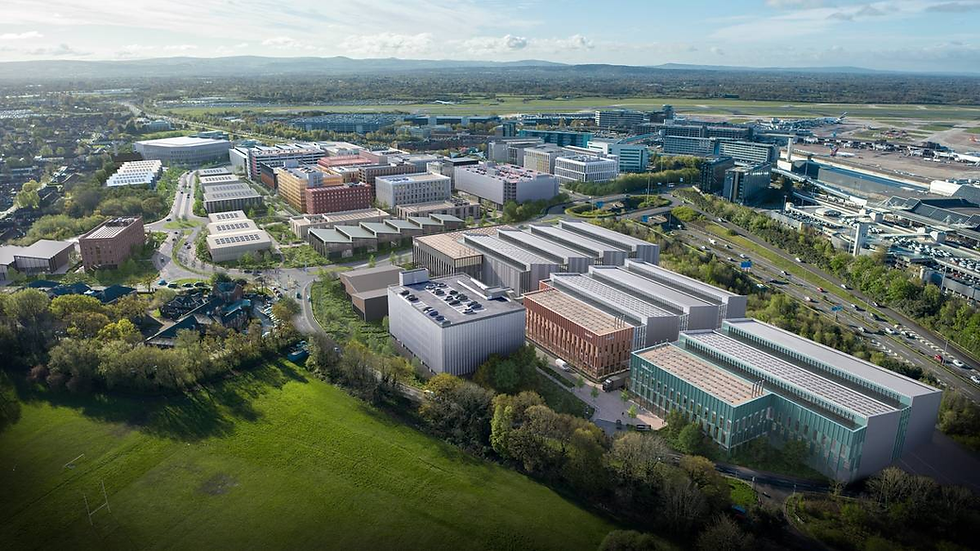
'And what we're trying to do at Mix Manchester is provide a master plan that offers a kind of full scale from R&D right the way through to pilot manufacturing and then into large scale manufacturing. of manufacturing facilities. They're not always good neighbours for residential because you can probably talk about 24-hour operations, large vehicles, so trying to design something that is organic.'
Sheppard Robson describes the project:
'The 24-hectare masterplan will accommodate a range of tenants, from small-scale research & development companies to large-scale advanced pharmaceutical manufacturing and mid-tech occupiers. The flexible framework - with a long-life, loose-fit approach - provides a scaled expansion to meet the changing needs of individual tenants and the evolving demands of the advanced materials, life sciences, digital and technology economies.
'The masterplan focuses on a series of neighbourhood blocks and a centralised pedestrianised town square, providing clusters of activity at a local level, allowing the site to develop sequentially over several phases. By integrating hotels, shared amenities and F&B/leisure facilities into these neighbourhoods, we have created active frontages and vibrant, people-focused spaces that encourage community and foster a sense of identity for tenants.
'A hierarchy of movement puts sustainable modes of transport at the heart of the site, with vehicular access and servicing infrastructure to the perimeter of the neighbourhood blocks.
'Our integrated approach to the public realm, landscape and placemaking provides structure to the masterplan, linking the neighbourhood blocks and providing a network of connections that promote interaction, communication and collaboration.'
Image: Mix Manchester, courtesy of Sheppard Robson.
Comments